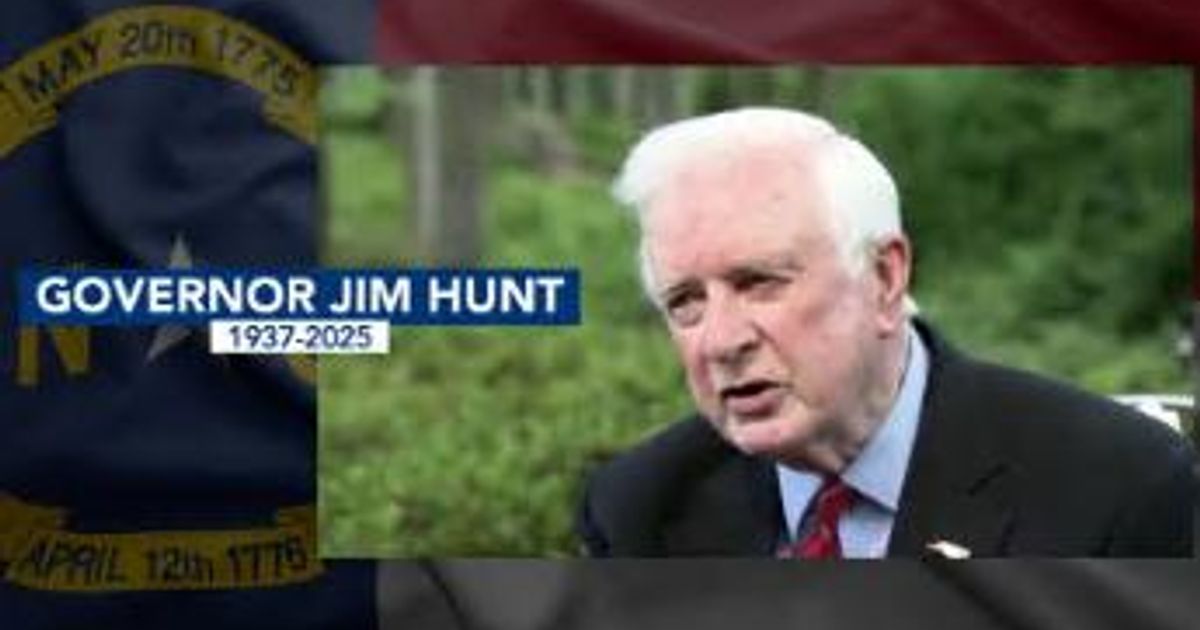
Former Gov. Jim Hunt, who redefined the office of governor in North Carolina, championed public education and helped focus the state’s economy on high-tech industries, has died. He was 88.
His daughter Rachel Hunt confirmed his passing.
The only four-term governor in state history, Hunt helped push through amendments to the state constitution that allowed governors to serve consecutive terms and gave them veto power – an option he never used himself. He also created the Smart Start pre-kindergarten program, helped establish teaching standards and backed the development of MCNC and the North Carolina Biotechnology Center.
“The job of governor of North Carolina is the best political job in America,” Hunt once said. “Being governor is such a wonderful opportunity … You can really make things happen.”
Early start in politics
Hunt grew up on his family’s tobacco and dairy farm in Wilson County but quickly eschewed farm life for politics. After watching the state pave the dusty road that led to the farm, he said, he learned that “through politics, you can make good things happen for people.”
While still in high school, Hunt was elected president of the North Carolina Junior Grange as well as state president of Future Farmers of America.
“I used to practice my speeches on my tractor while I plowed my daddy’s field,” he would often tell people.
His parents and his early memories helped shape Hunt’s political philosophy. His father worked in the soil conservation service and believed in protecting the environment, while his mother was a teacher who instilled the value of education in her children. Growing up amid the poverty of eastern North Carolina also showed him how rural families suffered because of a lack of decent jobs, inadequate health care and schools that weren’t as advanced as those in urban areas.
“I had very strong feelings about how people ought to be treated and the fact that they ought to have equal and good opportunities to achieve and to be something and to have a good life,” he once said.
His work with the Grange allowed him to meet Carolyn Leonard, an Iowa farm girl, at a national youth conference. They carried on a long-distance relationship for a couple of years – he would hitchhike to Iowa during school breaks to visit her – before marrying in 1958.
Hunt earned two agricultural degrees at North Carolina State University, but he made his biggest mark there by twice serving as student body president. After getting his law degree from the University of North Carolina at Chapel Hill, he served as president of what would later become the Young Democrats of North Carolina.
“That experience in student government at N.C. State really taught me a lot,” he said in a 2009 university video celebrating the 50th anniversary of his graduation. “As a student leader, I realized what our responsibility was. It wasn’t just a lark or something to have fun or to make trouble or whatever. We had a responsibility to help make the campus better and give students the opportunity for a better education.”
After two years in Nepal in the mid-1960s as an agricultural economist for the Ford Foundation, Hunt returned to North Carolina, joined a law practice in Wilson and built enough of a statewide base though his work with the Young Democrats to get elected lieutenant governor in 1972. He was the only Democrat to win statewide office in North Carolina amid Republican President Richard Nixon’s landslide re-election.
The fact that he had never served in the General Assembly didn’t endear him to some lawmakers, and they tried unsuccessfully to strip the lieutenant governor of his powers as Senate president.
“They didn’t really appreciate that this young whippersnapper had won the lieutenant governorship,” he once said. “I worked hard, I fought hard, I made friends and we won those battles. I kept those tools of leadership, and they served very well.”
Hunt played a key role in pushing legislation through the General Assembly, including bills that required children statewide to attend kindergarten, increased teacher pay and opened a medical school at East Carolina University. Yet, he failed in convincing lawmakers to ratify the Equal Rights Amendment in support of women’s rights.
Young governor redefines position
During his tenure as North Carolina’s second-in-command, he built his own county-by-county network of support outside that of the Democratic Party. The organization vaulted him to landslide victories in the 1976 primary and general election, where he downed former Department of Human Resources Secretary Dave Flaherty to win his first term as governor.
“Let us commit ourselves – here, today – to a new beginning in North Carolina,” he said in his inauguration speech.
Following in the footsteps of progressive Democrats like former Govs. Kerr Scott and Terry Sanford, Hunt pushed an agenda heavy on improving education, cleaning up government and expanding the state’s economy.
As his first act in office, he ordered high-level appointees to sign a code of ethics that required disclosure of financial interests. He also purged Republicans from the upper ranks of state agencies, clearing the way to appoint supporters who could carry out his proposals.
Hunt established a reading program in the first through third grades, limited class size to 26 students and pushed for the creation of the North Carolina School of Science and Mathematics, an elite public high school in Durham. His backing also led to the creation of the Public Staff Office to represent consumers before the state Utilities Commission.
In an effort to copy the success of Silicon Valley, he worked with lawmakers to launch the Microelectronics Center of North Carolina, now known as MCNC, in Research Triangle Park. The nonprofit became a technology catalyst for area universities, government agencies and private industry and helped computer-related businesses grow in the state.
“Jim Hunt was one of those remarkable governors who constructively led the South and the nation into the 21st century. To him, relieving youth of the burden of ignorance and poverty represented democracy’s greatest challenge,” the late Bill Friday, a former University of North Carolina president, once said.
Four years later, after securing the constitutional amendment allowing a second term, Hunt again won in a landslide, this time over state Sen. I. Beverly Lake Jr., a conservative who switched from the Democratic to the Republican party.
After focusing on the electronics industry during his first term, Hunt turned his attention to the growing life sciences industry. He traveled to England to persuade pharmaceutical giant Glaxo plc to set up a U.S. base in RTP, and he worked with lawmakers to open the North Carolina Biotechnology Center to assist companies, government agencies and area universities with policy research, business loans and other support.
“Jim Hunt was the defining political leader of North Carolina in the 20th century,” Bob Ingram, former chief executive of Glaxo successor Glaxo Wellcome, once said. “His vision, commitment and energy transformed the state. North Carolina leads the South in education, technology and social policy, all thanks to Jim Hunt’s leadership.”
Bitter Senate battle leaves scars
As his second term drew to a close, Hunt prepared to challenge U.S. Sen. Jesse Helms, who was seeking a third term in Congress. Hunt said he liked Helms as a person but said his ultra-conservative policies didn’t serve North Carolina or its residents well.
“I saw him as a very divisive force,” Hunt said later. “I just thought he was not a positive, constructive force in building the kind of North Carolina that I wanted to see us have and thought we needed.”
Harrison Hickman, a Washington political consultant and North Carolina native, said at the time that the showdown forced state voters to choose between two popular politicians.
“The problem for most people in the state is that they would like to keep the two of them,” Hickman said. “Helms has a charismatic hold on half the people of North Carolina even though they disagree with him on the issues. Hunt has the solid image of a can-do governor.”
In a campaign Hunt described as “ugly,” Helms’ advisers used political ads to divide Democrats along racial lines, including one that pictured Hunt with civil rights leader Jesse Jackson. They also courted Rev. Jerry Falwell, whose Moral Majority organization painted Hunt as a bad Christian in churches across North Carolina.
Helms and Hunt combined to spend $30 million in the campaign, which remains the most expensive campaign in state history.
Hunt’s campaign was slow to respond to Helm’s barrage of attack ads, believing that the voters who had overwhelmingly elected Hunt twice would dismiss the negative allegations. But the ads gradually eroded Hunt’s lead in the polls.
“They were changing people’s perception about me,” he said later. “Instead of thinking about me as that positive, successful, strong, active governor that I’d been … people began to have questions about me.”
Calling his campaign “naive,” Hunt said they didn’t fight back effectively, which cost him the election.
“He was tearing me down as a person, and I was talking about the issues,” he said. “I’d have to say their ads worked.”
To get past the sting of defeat, he plunged back into his gubernatorial work. One of his final acts in office was to set aside about 350 acres of the Dorothea Dix Hospital campus in south Raleigh to give North Carolina State University room to expand. Following his recommendation, another 450 acres of the Dix campus that had been a cattle farm also was shifted to N.C. State, and the two parcels combined to create the university’s cutting-edge Centennial Campus, a research campus where the school can partner with businesses.
After leaving office, Hunt moved back to Wilson County to operate his family’s farm and practice law. Yet, he continued to travel and educate himself on economic development and school reform. By 1990, he said, he began to consider another run at the governor’s office, saying he felt the gains made during his eight years in office had leveled off.
“I wanted us to be at the top,” he said. “I had grown up in this state where people thought the best you could ever be was first in the South. I knew because of things I had done and seen and learned that we could be better than that.”
Return to Governor’s Office
Hunt focused his campaign on further education reforms, which he said would boost the state economy, and defeated Lt. Gov. Jim Gardner to win an unprecedented third term.
One of his first priorities was to establish Smart Start to boost early childhood education.
“In my first two terms in the 1970s, we focused on elementary and high schools. We realized we were starting too late. We knew to be effective we had to start even earlier,” he said.
The public-private partnership sent state funds to local nonprofits to support pre-kindergarten classes, child care, access to health care and parenting initiatives. Although audits revealed financial mismanagement at some of the organizations, Hunt said community ownership of the program was important to its overall success.
“I’m so proud of what we did for education and the children. That’s the future,” he said later.
By the mid-1990s, North Carolina was the only U.S. state where the governor lacked veto power. Lawmakers repeatedly defeated efforts to pass veto legislation, but Hunt said “the planets just sort of lined up” after Republicans gained control of the state House in the 1994 mid-term elections. With support from House Republicans and Senate Democrats, he was able to finally push legislation creating a gubernatorial veto through the General Assembly.
“After that was put in place, the governor of North Carolina was no longer the weakest governor in the country,” he said.
Hunt also took on crime and environmental issues in his third term. Lawmakers increased penalties on serious crimes and created alternative schools for troubled youth and other prevention programs during a special legislative session. The state also placed a moratorium on new hog farms and began annual inspections of existing ones after a hog waste lagoon spill.
When it came time to run for a fourth term, however, his focus returned to education, and he easily defeated state Rep. Robin Hayes. He later held his inauguration ceremony at Broughton High School in Raleigh to emphasize his dedication to schools.
Hunt pushed for increasing the pay for teachers to the national average, as well as holding teachers to higher accountability standards. His Excellent Schools Act was backed by the North Carolina business community and was quickly approved by lawmakers.
“People don’t want to pay more for the same old thing. They want to pay more for something better,” he said.
During his final years in office, Hunt played a key role in negotiating a national settlement with cigarette makers to end lawsuits by states over the health costs of smoking, and he established Golden LEAF, a foundation to distribute North Carolina’s share of the settlement to help tobacco farmers transition to other crops and push economic development in rural counties.
He also was confronted with a disaster of biblical proportions when Hurricane Floyd left much of eastern North Carolina under water. He called for a special legislative session, and when the $836 million the General Assembly approved for recovery efforts turned out to be insufficient, he went to Capitol Hill to obtain more, using a yardstick to show members of Congress how much water had inundated the state.
After leaving office in 2001, he occasionally dipped his toes back into politics, such as lobbying for more funding for early childhood education programs. But most of his time was devoted to working with economic development clients for the Womble Carlyle Sandridge & Rice law firm and to leading the Institute for Emerging Issues, a think tank he helped create at N.C. State, and the James B. Hunt Jr. Institute for Educational Leadership and Policy at UNC-Chapel Hill.
“No one I know has done more to shape and expand the future of his state than North Carolina’s Jim Hunt.” David Broder, the late political columnist for The Washington Post, once said.