Versant began trading on the Nasdaq under the ticker symbol “VSNT,” opening at $45.17 per share.
The company’s so-called “when-issued” stock — a security that is expected to be issued and has been authorized to trade on a conditional basis to give investors an early chance to buy shares — initially began trading on Dec. 15 at $55 per share and ended trading Friday at $46.65 per share. Monday’s early trading marked a decline of roughly 10%.
The company’s market capitalization stands at roughly $6.5 billion with shares outstanding of 145.76 million based on the spin-off ratio. As part of the spinoff, Comcast shareholders received one share of Versant stock for every 25 shares of Comcast stock they owned.
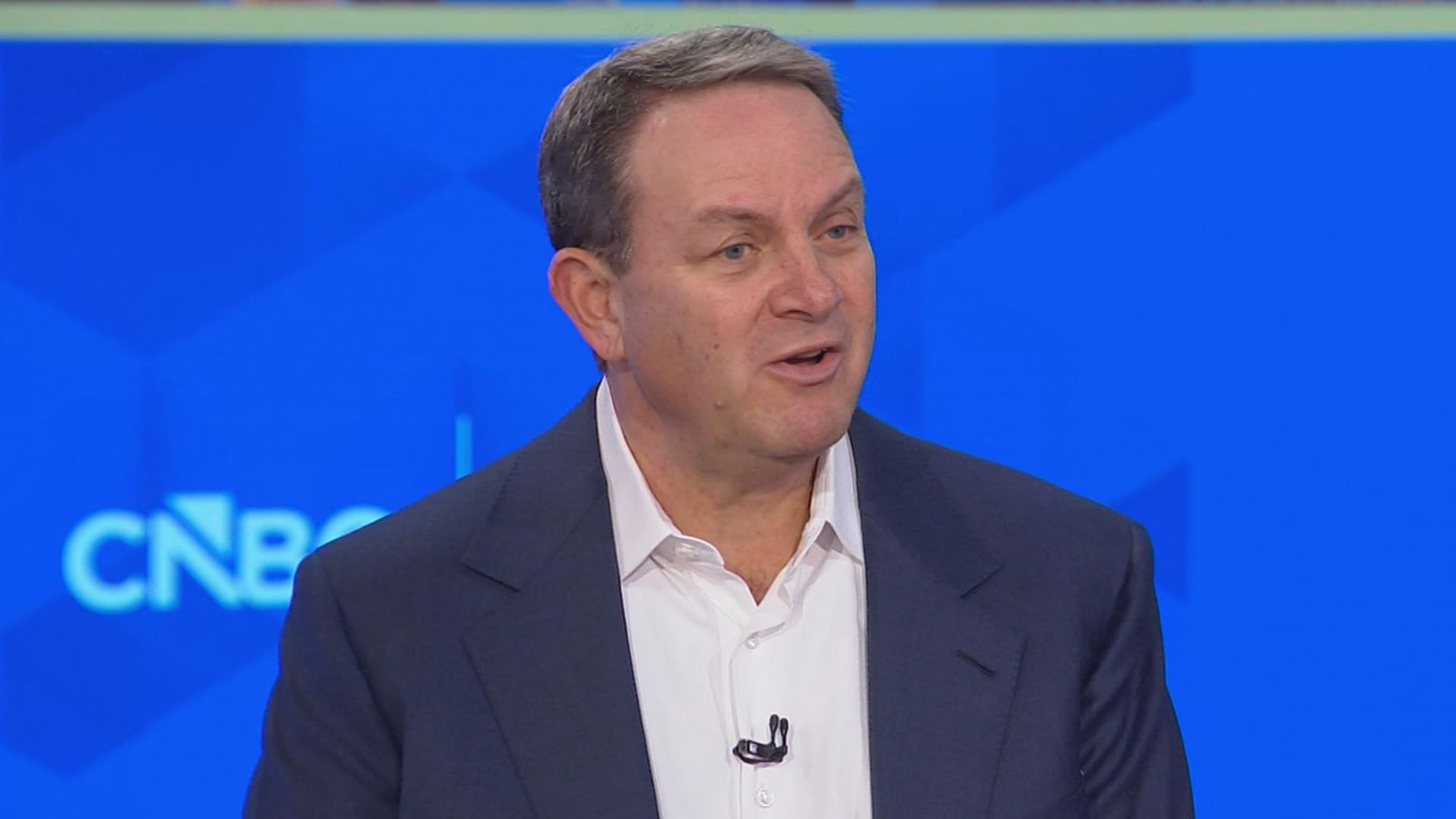
“It’s been a year in the making,” said Mark Lazarus, Versant CEO, on CNBC’s “Squawk Box” Monday.
In November 2024, Comcast announced its intention to separate out the bulk of NBCUniversal’s cable TV networks, including MS Now (formerly MSNBC), CNBC, Golf Channel, USA, E!, Syfy and Oxygen, as well as digital properties Fandango, Rotten Tomatoes, GolfNow and Sports Engine.
“As part of Comcast and NBCU we had other priorities as a company,” Lazarus said. “We made different decisions, because we had a different company and a different strategy. Now we’re bringing these [assets] into their own company, we’re going to be able to invest into them. We’ll invest organically … and hopefully the market is listening to what we’re saying.”
Lazarus said “vertical scale” is necessary to diversify the business away from a dependence on pay TV.
“While that’s still a big, profitable part for us, it’s not going to be the end game,” he said.
There are few traditional media companies that have gone public in recent years — namely due to the significant challenges the industry has been facing due to the shift away from the TV bundle and toward streaming.
In 2025, Newsmax, the conservative cable news network, went public on the New York Stock Exchange and quickly saw its shares soar from its $14 per share opening price. It has fallen precipitously since its debut.
Instead, the media sector has been marked by a rush for consolidation and fresh M&A deals. Paramount Skydance completed its merger last year, and since then CEO David Ellison has been acquisitive. Warner Bros. Discovery, itself formed following a merger in 2022, last year kicked off a sale process that resulted in a proposed deal with Netflix. Paramount has since made a hostile offer to WBD shareholders to upend the proposed transaction with Netflix.
Brendan Mcdermid | Reuters
The company has also highlighted its strength in news and sports, the two categories of programming that still receive the bulk of TV viewers. Although networks like those in Versant’s portfolio are seeing declines in financials, they are still profitable and beckon ad dollars.
On Monday Lazarus once again pointed to Versant’s weight in sports and news, saying 62% of the portfolio is in those two content areas.
“We have a really strong position,” Lazarus said.
In September Versant reported declining revenue in recent years as consumers exit the cable TV bundle.
Per a filing with the Securities and Exchange Commission ahead of going public, Versant’s assets generated $7.1 billion in revenue in 2024 , down from $7.4 billion in 2023 and $7.8 billion in 2022. The company said its net income attributable to Versant was $1.4 billion in 2024, down from $1.5 billion in 2023 and $1.8 billion in 2022.
Shortly after, ratings agencies S&P Global and Fitch Ratings each issued BB credit ratings on the company’s debt noting stable outlooks, placing the company’s rating in junk territory. This was based on Versant’s plans to issue $2.75 billion of new senior secured debt to fund a one-time $2.25 billion cash distribution to Comcast and add $500 million to its balance sheet, according to S&P.
Versant’s low debt levels have boded well for the company with both ratings agencies and have been a highlight in its pitch to Wall Street investors. Media peers like Warner Bros. Discovery have grappled with heavy debt loads while also contending with the decline of cable TV subscribers and lower ad revenue.
Both ratings agencies noted the headwinds facing the traditional TV landscape, which S&P said “offset the strength of [Versant’s] portfolio,” noting that revenue from linear distribution and advertising from its networks accounted for more than 80% of total revenue.
Fitch said “the strong viewer loyalty and engagement” to Versant’s TV networks, as well as its conservative debt structure, bodes as a positive for the company.
Versant executives said at a recent investor day presentation the company intends to grow its digital business through acquisitions and investments.
— CNBC’s Gina Francolla contributed to this article.
Disclosure: Versant is the parent company of CNBC.