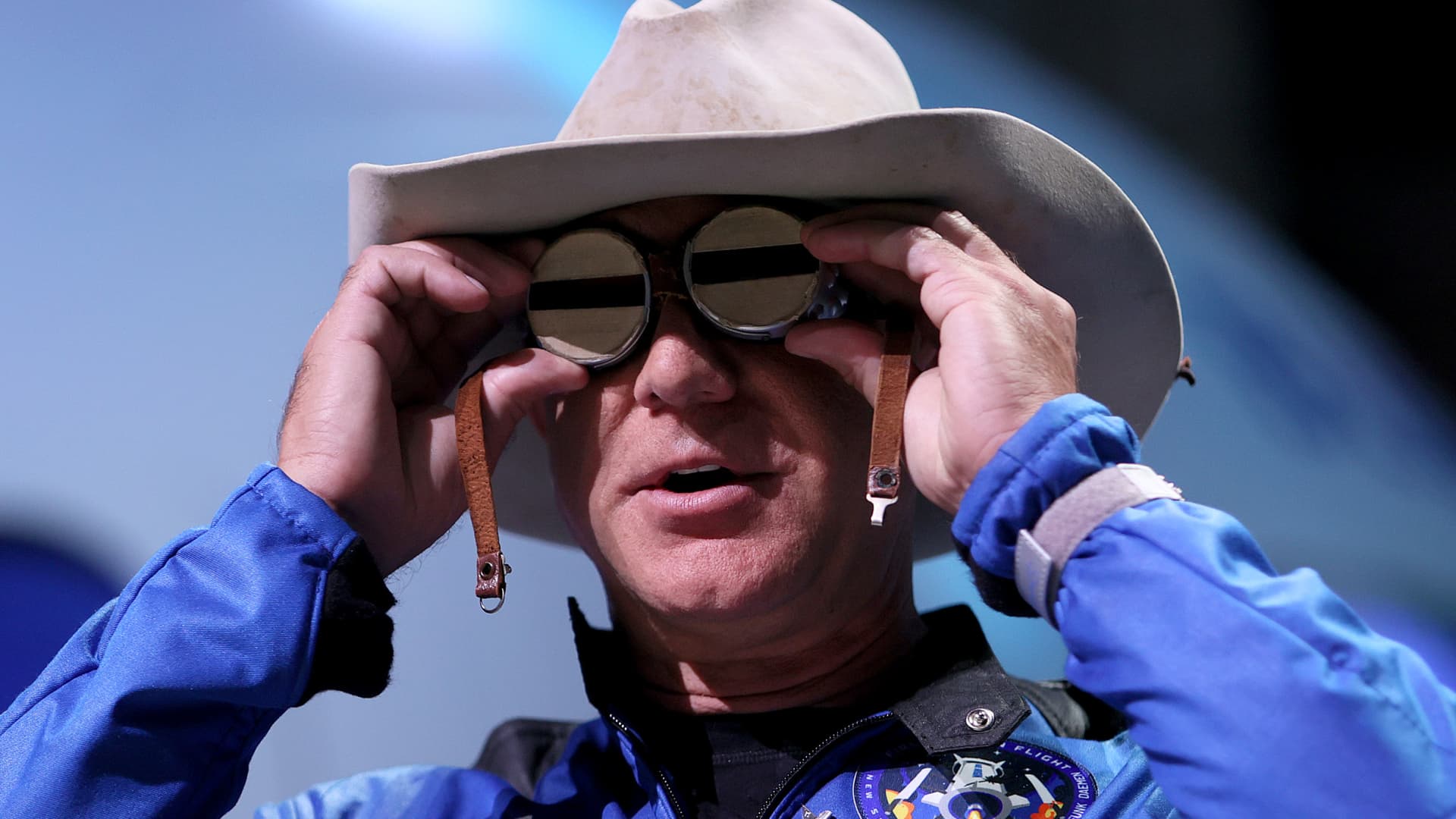
Joe Raedle | Getty Images
The network, called TeraWave, is targeted for enterprise, data center and government users.
The company said it will provide data speeds of “up to 6 terabits per second” from satellites positioned in low Earth orbit and medium Earth orbit, regions of space that are between 100 miles and 21,000 miles from the Earth’s surface.
Blue Origin said it expects to begin deploying its constellation in the fourth quarter of 2027.
Bezos is entering an increasingly crowded satellite internet market that’s currently dominated by Starlink, a service operated by Elon Musk‘s SpaceX. Starlink has more than 9,000 satellites in orbit and roughly 9 million customers.
The company has sent up 180 satellites since last April through a series of rocket launches handled by partners such as United Launch Alliance and SpaceX.
Several future deployments are expected to be handled by Blue Origin.
Amazon aims to build a constellation of 3,236 low Earth satellites that will serve businesses, governments and consumers. Last November, the company opened up an “enterprise preview” to select users ahead of a broader commercial launch.
Bezos predicted in 2024 that Blue Origin would one day be a bigger company than Amazon. He founded Blue Origin in 2000, and Dave Limp, Amazon’s former devices boss, serves as its CEO.
“I think it’s going to be the best business that I’ve ever been involved in, but it’s going to take a while,” Bezos said in a 2024 interview at The New York Times’ DealBook Summit.
Blue Origin is primarily a rocket launch company, flying tourists and research to the edge of space on short trips. Last January, the startup notched a major milestone when it successfully launched its towering New Glenn rocket for the first time, though it was unable to return the rocket’s booster back to a barge for reuse. Blue Origin nailed the landing of its New Glenn rocket booster last November following the successful launch of a pair of NASA spacecraft.