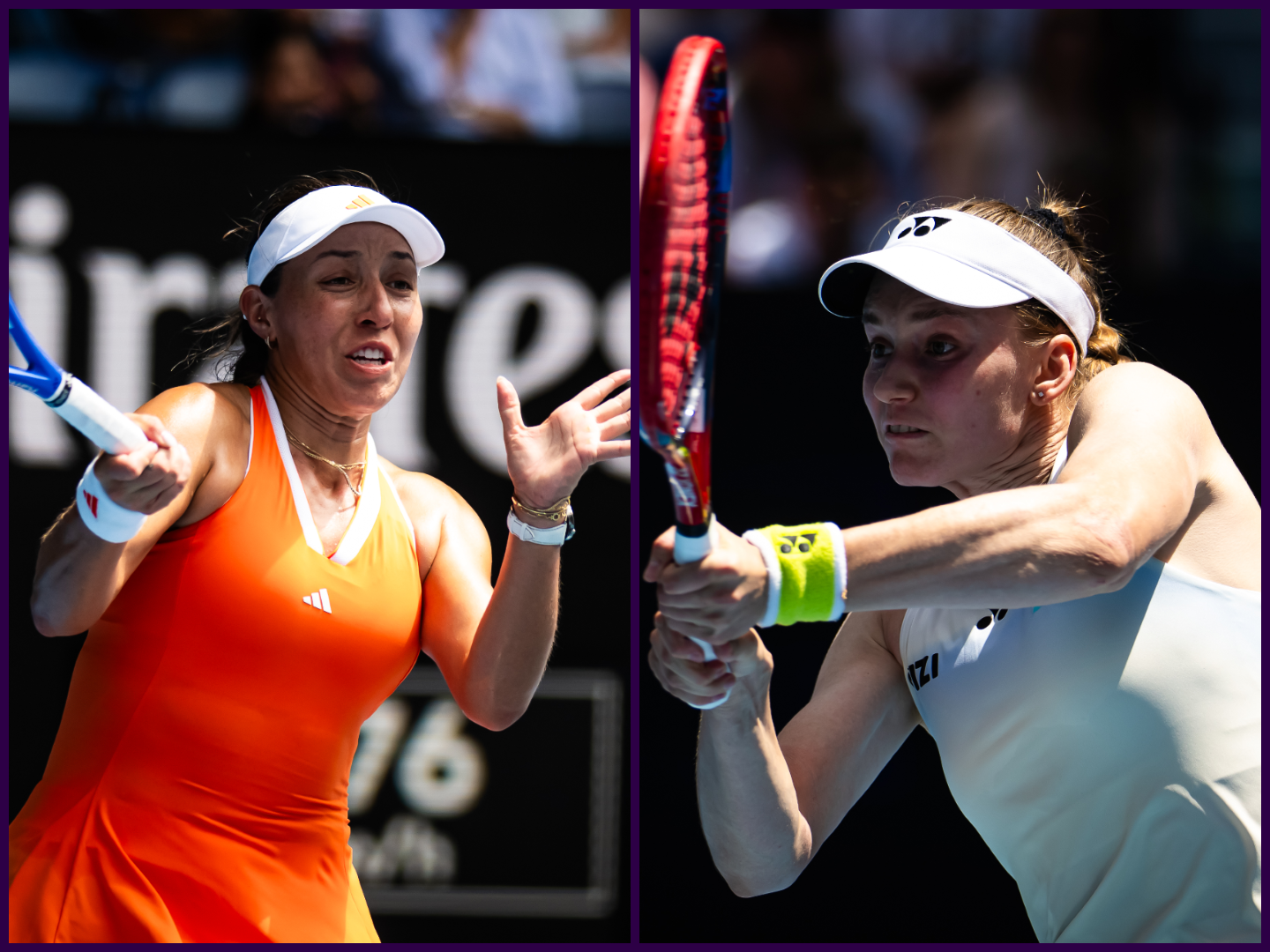
Rybakina was a 7-5, 6-1 winner over No. 2 seed Iga Swiatek, ending her hopes (for the moment) of achieving the career Grand Slam. Rybakina finished with a flourish, winning eight of the last nine games.
Pegula took down No. 4 seed Amanda Anisimova 6-2, 7-6 (1) to advance to her second straight major semifinal.
No. 1 Aryna Sabalenka, seeking her third Australian Open title and her fourth straight final, will meet No. 12 Elina Svitolina in the first semifinal (7:30 p.m., local).
The key to Pegula’s victory? Complete command in the critical category of second serves. Pegula won 16 of her 25 second-serve points (.640), while Anisimova hit seven double faults — all in the winnable second set.
“I’ve always been someone that doesn’t really panic — I don’t really get too emotional,” Pegula told reporters. “I don’t really get too upset about things, so I think that’s just kind of where the stability comes from. I’m very persistent as far as always wanting to get better, always wanting to work on stuff, always feeling like I can do things that maybe people thought I couldn’t, and kind of improve in those areas.”
Rybakina, the 2022 Wimbledon champion, says that maturity and quickly adapting to little challenges are necessary to win seven matches in a fortnight.
“You can play indoor, you can play outdoor, sun, it can be [a] night match,” she explained. “So all these conditions [are] a bit tricky. I think probably now I’m more calm and going deeper in tournament.”
How in form are these four WTA Tour semifinalists? None of them have dropped a set; it’s only the fifth time that’s happened at a major in 30 years.
We break down these two stellar matches, with thoughts from writers Greg Garber and Brad Kallet:
Australian Open semifinal (approximately 9:30 p.m. local)
No. 5 Elena Rybakina vs. No. 6 Jessica Pegula
Head-to-head: 3-3. Rybakina won the last one — in a three-setter in Riyadh, last fall — but they’ve never met at a Grand Slam.
What’s at stake: A whole lot for these two players, for different reasons. This is Pegula’s second straight major semifinal, and she’s looking to make her second final in three semifinal tries. She’s the only woman in the Open era to advance to her first three Grand Slam semifinals after her 30th birthday.
Rybakina is trying to get back on the Grand Slam title board for the first time in three-and-a-half years. She’s also looking to equal her best result in Melbourne, when she lost to Sabalenka in the 2023 final. Rybakina’s followed up her title at the WTA Finals with a strong start in 2026, winning seven of eight matches.
The Case for Rybakina
Greg Garber: It’s not common knowledge, but since Wimbledon last year, Rybakina has won more matches (35) than any other woman. The current run is 18 of 19, losing only to Karolina Muchova earlier this month in Brisbane. Perhaps more relevant, Rybakina has claimed an impressive eight consecutive Top 10 wins. And, as you know, Brad, Pegula is a Top 10 player.
“I think last season, the last couple of tournaments I played I gained some confidence throughout tough matches,” Rybakina said. “Of course, this is something I tried to carry to this year, this season. I’m trying to stay aggressive whenever I get the chance to step in, maybe risk a little bit.”
Rybakina likes these warm conditions Down Under. She hammered 11 aces against Swiatek and converted four of seven break points. Rybakina leads all women in Melbourne with 35 aces. “The most important for me,” she said, “[is] to be focused on my serve, since it’s a big advantage if it works.” If it’s working, don’t fix it. Rybakina in three sets.
The Case for Pegula
Brad Kallet: Pegula tends to slip under the radar, doesn’t she, Greg? Everyone knows how good she is, but we often take her consistency for granted. Take this year in Melbourne: Much of the talk was about Coco Gauff as the top-ranked American, Anisimova as the very likely first-time Grand Slam champion, Madison Keys as the defending champion. Even Iva Jovic generated more buzz, with her run to the quarters.
But Pegula, as solid and dependable as they come, is the last American standing. She’ll have her work cut out for her in Rybakina, who is playing as well as anyone on tour, but the 31-year-old knows how to handle the power players. Just look at her quarterfinal match against Anisimova as proof. If she can neutralize Rybakina, change direction, create unforced errors and maintain her dominance on second serve, she has a great shot. We haven’t had a down-to-the-wire three-setter in a bit, Greg, but I agree that we’ll get one tonight. Pegula gets it done and reaches her second Slam final.