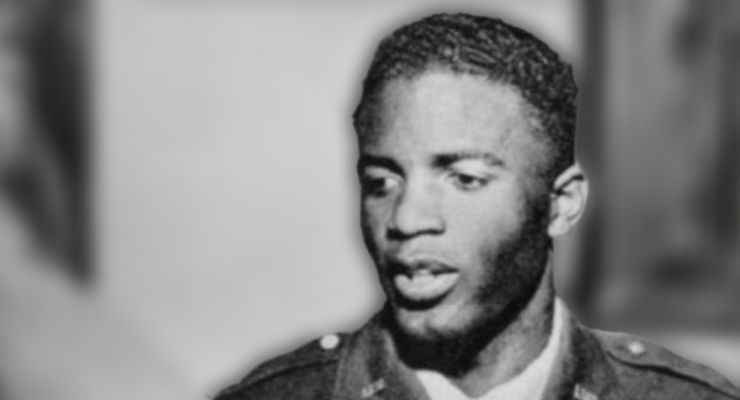
Photo of Jackie Robinson in his military uniform, during a visit to his Pasadena family home, c. 1943. [LOOK Magazine]
Before Jackie Robinson broke baseball’s color line, before he starred in four sports at John Muir High School, before he became a name that would shape Martin Luther King Jr.’s sense of what was possible — he was a kid on Pepper Street, figuring things out like everyone else.
That’s the Robinson the Pasadena Public Library wants people to meet on Friday.
“We focus on Jackie as a kid and teenager navigating school, sports, family expectations and difficult choices long before the world knew his name,” said Tiffany Dueñas, a library technician and co-presenter for the event.
The program, titled “Jackie Robinson: Beyond Baseball,” marks what would be Robinson’s 107th birthday. He was born Jan. 31, 1919.
But the celebration reaches further back — to 1853, when Robert Owens, a Black frontiersman, arrived in Pasadena.
That’s 66 years before Robinson was born.
“Jackie’s childhood fits into a much longer and deeper history of Black life in Pasadena,” Dueñas said. “Pasadena’s Black history didn’t begin with one person, and is still being learned today.”
History boards created by the Pasadena Historical Society in 1985 will be on display, highlighting early research into Pasadena’s Black community before 1930. The boards feature Owens, Ray Bartlett, and both Robinson brothers — Jackie and Mack, who won an Olympic silver medal in 1936.
The library’s own collections — books, photographs, newspaper archives and local history materials — help ground Robinson’s story in real places and lived experiences, Dueñas said.
The program uses a myth-versus-fact format to challenge assumptions about Robinson’s path.
One myth: that Robinson’s success was only about baseball. The fact: at John Muir, he played football, basketball, track and tennis.
Another myth: that he did everything on his own.
“His family, especially his mother, siblings and the community around him helped shape who he became,” Dueñas said. “At the same time, he gave back to that community by standing up for fairness and pushing for change.”
Watching his brother Mack return from Olympic glory to limited opportunities at home taught Jackie something early.
“That experience shaped how he understood fairness and opportunity long before baseball entered the picture,” Dueñas said.
The notion that Robinson always dreamed of playing Major League Baseball is itself a myth. Dodgers historian Mark Langill, speaking at a 2019 South Pasadena program marking Robinson’s 100th birthday, described the Branch Rickey–Jackie Robinson combination as “the greatest accident the sport could ever hope for.”
Branch Rickey was the Brooklyn Dodgers’ top baseball executive in the 1940s, and he was the one who decided to break Major League Baseball’s color barrier by signing Jackie Robinson and bringing him to the Dodgers.
Yes, Robinson grew up in a Pasadena “full of possibility, but also real barriers,” Dueñas said. “And that tension still exists today.”
“One clear parallel is that opportunity is still shaped by access, support and community,” she said.
Dueñas is presenting alongside Pasadena History Librarian Young Phong at the Jackie Robinson Community Center, 1020 N. Fair Oaks Ave. The center sits in the neighborhood where Robinson grew up and was dedicated in his name on June 2, 1974.
Annual birthday commemorations at the center have become a tradition. In 2023, the center marked the 104th anniversary of Robinson’s birth with a memorabilia display. In 2024, an exhibit on loan from the Pasadena Baseball Reliquary featured a Grays jersey, Negro League items, historical pictures and a model of Ebbets Field. Robinson family members attended that celebration.
This year’s event will feature a self-guided tour of the Jackie Robinson baseball exhibition and birthday treats. The history boards won’t be walked through during the program, but attendees are invited to explore them afterward.
King once said Robinson made it possible for him to become the man he became. Dueñas sees that influence as rooted in place — in Pepper Street, in the family who raised him, in the community that shaped his sense of fairness before the world knew his name.
“Jackie learned early on that progress doesn’t happen automatically,” Dueñas said. “It takes courage, support and choices. That lesson still feels relevant in Pasadena today.”
That’s the story they’re slowing down to tell — Robinson before the headlines, still figuring things out, in the neighborhood where it all began.
“Jackie Robinson: Beyond Baseball,” Friday, Jan. 30, 11 a.m. to 1 p.m. Jackie Robinson Community Center, 1020 N. Fair Oaks Ave., Pasadena. Program recommended for ages 9 and older. For information or to request a disability-related accommodation, call (626) 744-7300. Free.