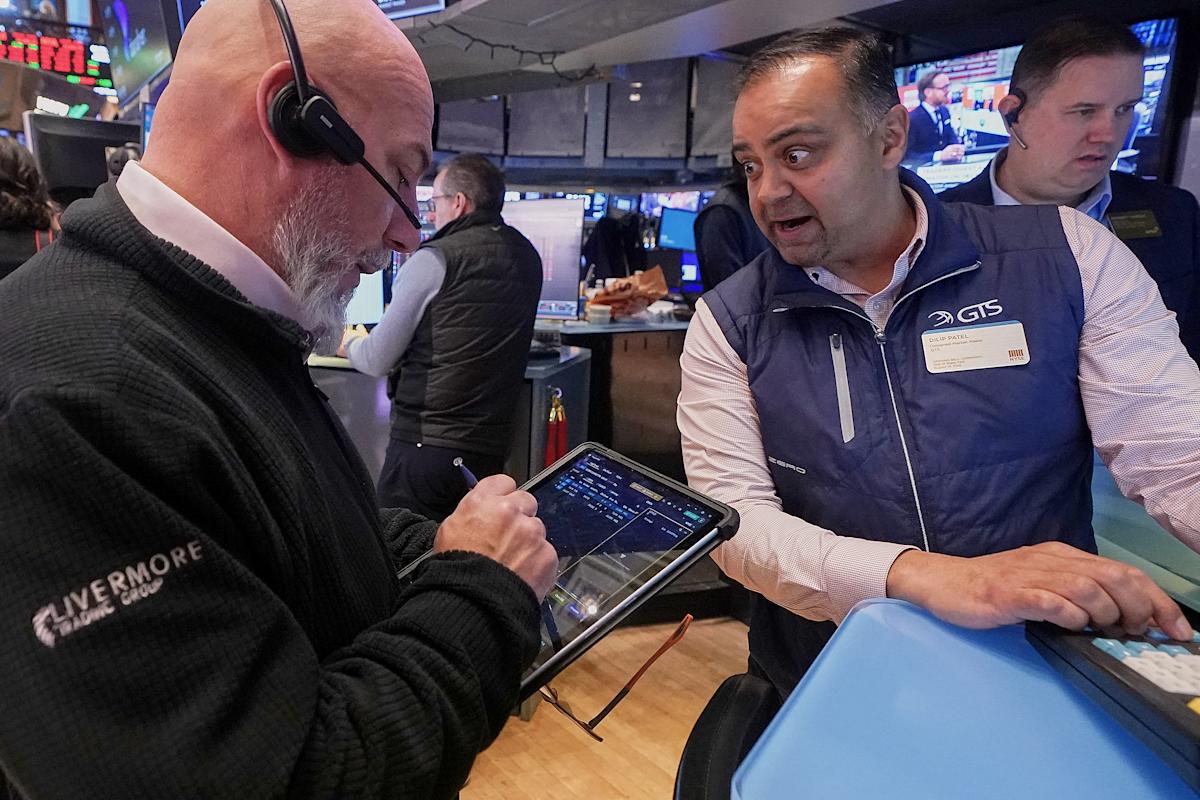
Dow crosses 50,000 mark, leading S&P 500, Nasdaq higher as Wall Street rebounds from rout

Spread the love


US stocks jumped on Friday, set to rebound from a weeklong tech bruising as Wall Street reassessed worries about the impact of AI disruption and the risks of hefty Big Tech spending.

The Dow Jones Industrial Average (^DJI) led the way higher, surging by about 2.2%, or more than 1,000 points, to climb ahead of the 50,000 level for the first time. The S&P 500 (^GSPC) rose 1.7%, while the Nasdaq Composite (^IXIC) added about 2%, as the indexes bounced back from Thursday’s sharp closing losses and a week’s worth of selling pressure.

Wall Street is ending the week with a bounce back, as Big Tech CEOs and analysts brush aside concerns about the impact of new AI tools on legacy tech. The S&P 500 again turned positive for 2026, but the benchmark and the Nasdaq remain on track for weekly losses.

Some of tech’s biggest names led the charge. Nvidia (NVDA) surged over 7%, while Broadcom (AVGO) and Tesla (TSLA) posted sizable gains. Some tech gloom persisted as Amazon’s (AMZN) shares tumbled 7%. In its earnings, the major cloud provider outlined plans for a massive 2026 jump in spending to at least $200 billion, even as its forecast for operating income fell short.

The tentative risk-on tone extended beyond stocks, as bitcoin (BTC-USD) climbed steadily back to above $68,000, having touched a 16-month low overnight. But the biggest cryptocurrency is still on track for its worst weekly performance since 2022 after wiping out all of its post-Trump election gains this week.

Strategy (MSTR), one of the companies most affected by the crypto slump, revealed a loss for the quarter. The results initially weighed on its stock, but shares were up over 13% on Friday as bitcoin revived and Strategy’s CEO played down concerns about debt-servicing risks.

Elsewhere, Stellantis (STLA) warned it will take a charge of over 22 billion euros ($26 billion) in a plan to scale back its EV push. Shares in the Jeep maker tanked over 20% on Wall Street and in Milan (STLAM.MI).

Looking ahead, the release of the closely watched January jobs report, originally scheduled for Friday, has been pushed to Wednesday next week. Fresh signs of trouble in the labor market emerged in recent days, as job openings sank to their lowest level since 2020 and layoff announcements surged.

LIVE 18 updates

  • Dow crosses 50,000 benchmark, hits intraday high

    The Dow Jones Industrial Average (^DJI) surged more than 2.2% on Friday to touch a fresh intraday record and surpass 50,000 for the first time.

    The record comes on the heels of a volatile week as investors rotated away from tech and into defensive and cyclical sectors.

    The S&P 500 (^GSPC) rose 1.7%, while the Nasdaq Composite (^IXIC) added about 1.9% with the indexes bouncing back from sharp closing losses.

  • Laura Bratton

    Dot-com era companies are getting revived by AI

    Fiber company Corning (GLW), storage provider Western Digital (WDC), and networking hardware and telecomm equipment maker Cisco (CSCO) are just a few examples of companies whose stocks have ripped back to highs unseen since their dot-com era booms.

    Corning is up more than 125% over the past year, while Western Digital and Cisco have soared 478% and a more modest 35%, respectively. The three were dot-com era stars that lost much of their value during the bubble’s burst and failed to fully recover until the AI boom, as the massive data center build-out by cloud giants has fueled demand for their products.

    Corning (GLW), for example, recently announced a deal with Meta (META) worth up to $6 billion as tech giants rush to secure fiber that connects data centers to one another and their enterprise clients.

    Corning’s boost has extended to its customer Lumen (LUMN), too — a telecomm infrastructure company that acquired Qwest. Communications and indirectly absorbed Global Crossing, two internet era players that struggled or failed after the dot-com bust. Lumen shares climbed 26% Friday to recover from a weeklong drop, and the stock is up 57% over the last year.

    Lumen said this week it has $13 billion worth of fiber deals in the pipeline as AI boosts demand.

    ” Two years ago, the company was in serious financial trouble,” CFO Chris Stansbury told Yahoo Finance in a recent interview. ” The balance sheet’s now really strong,” partly thanks to a growing boost by AI data centers’ “insatiable demand” for fiber.

  • Ines Ferré

    Fed’s Jefferson signals higher bar for cuts, sees rates in ‘neutral range’

    Yahoo Finance’s Jen Schonberger reports:

    Read more here.

  • Brett LoGiurato

    Dow soars 1,000 points in wild market rebound from rout

    Wall Street was rebounding in a big way from a weeklong tech-fueled rout, with the Dow (^DJI) up over 1,000 points in midday trading to within striking distance of the 50,000 mark.

    The Nasdaq Composite (^IXIC) and S&P 500 (^GSPC) were both up nearly 2%.

    Caterpillar (CAT) was the Dow component leading the charge — you can read more on that company below from my colleague, Grace O’Donnell.

    Elsewhere, tech names that have been crushed all week were shining. Nvidia (NVDA) soared over 7%. Tesla (TSLA) was up nearly 4%. Microsoft (MSFT) rose close to 2%. The big exception was Amazon (AMZN), whose shares sank over 6% — which did represent a rebound from an earlier 10%-plus decline.

  • Caterpillar stock ascends to intraday high, helping to lift the Dow

    Dow component Caterpillar (CAT) rose 6% on Friday, helping lift the Dow Jones Industrial Average (^DJI) over 900 points to within an arm’s reach of the 50,000 mark.

    Caterpillar stock is up 25% year to date, reflecting expectations that increased spending by Big Tech companies on AI and data center infrastructure will fuel Caterpillar’s bull case. The stock hit an all-time intraday high above $720 per share.

    In addition to making heavy machinery and construction equipment, Caterpillar sells energy and power systems that have been increasingly in demand for AI use cases. The company reported a record backlog of orders heading into 2026.

    “In a few short years [Caterpillar has] become the ultimate story stock,” Barclays analysts wrote following the company’s earnings report last week. “From AI/Power to infrastructure to now critical minerals, CAT touches several of the big themes that dominate the market.”

  • How much is Big Tech set to spend on AI in 2026? Approximately $650 billion.

    How much capex on artificial intelligence is too much capex?

    As Wall Street reassesses its concerns about AI spending, my colleague Laura Bratton breaks down just how much Big Tech is shelling out for AI chips, servers, and data center infrastructure.

    She writes that the four Big Tech “hyperscalers” — Microsoft (MSFT), Alphabet (GOOGL, GOOG), Amazon (AMZN), and Meta (META) — are on track to spend upward of $650 billion on artificial intelligence investments this year. By company, here’s what that looks like:

    At the low end of that range, the four would spend about $635 billion, marking a roughly 67% spike from the companies’ $381 billion in expenditures in 2025. At the high end of their guidance, the group would spend around $665 billion, or a 74% jump from the previous year.

    Read the full story here.

  • Laura Bratton

    Bitcoin price rebounds to $67,000, remains on track for worst week since 2022

    Yahoo Finance’s Ines Ferré writes:

    Read more here.

  • Consumer sentiment hits highest level since August, but is down 11% from year ago

    Yahoo Finance’s Brooke DiPalma reports:

    Read more here.

  • Laura Bratton

    Nvidia shares rise nearly 5% as Big Tech’s 2026 capex set to soar above $600 billion

    Nvidia (NVDA) stock spiked 4.6% in Friday morning trading as the chipmaker was set to benefit from the more than $600 billion in capital expenditures planned by the four Big Tech hyperscalers: Microsoft (MSFT), Amazon (AMZN), Alphabet (GOOGL), and Meta (META).

    Amazon said on Thursday that it will spend around $200 billion in 2026.

    On Wednesday, Alphabet said its capex would fall between $175 billion and $185 billion.

    The previous week, Meta forecast it would spend anywhere from $115 billion to $135 billion. Microsoft hasn’t shared its full-year spending outlook, but if it continues to spend at the same rate as the first half of its fiscal year 2026 — which began in July of 2025 — the Azure cloud provider would see about $145 billion in capex.

    At the low end of that range, the four would spend about $635 billion this year, marking a roughly 67% spike from the companies’ $381 billion expenditures in 2025. At the high end of their guidance, the group would spend around $665 billion, or a 74% jump from the previous year.

    ” It’s all going to Nvidia,” DA Davidson analyst Gil Luria said in an interview with Yahoo Finance Friday morning of the capex figures.

    He said that while Nvidia shares have come down about 4% over the past three months — as have fellow AI chip designers Broadcom (AVGO) and AMD (AMD), which dropped about 9% and 14% in that time frame, respectively — investors will likely start once again “giving credit to the companies that are capturing all the profits” from Big Tech’s AI investments.

  • Laura Bratton

    Stocks turn higher at the market open

    US stocks rose early Friday in a sign of cautious optimism for rebound after a week-long tech rout.

    The S&P 500 (^GSPC) rose 0.5%, while the Nasdaq Composite (^IXIC) added roughly 0.2%, recovering from early premarket declines. The Dow Jones Industrial Average (^DJI) also climbed 0.8% after sharp losses for stocks on Thursday.

  • Hims & Hers stock tanks, Novo Nordisk rises as FDA targets copycat drugs

    Hims & Hers Health (HIMS) and Novo Nordisk (NVO) stocks saw a reversal of fortunes on Friday morning after the FDA announced a crackdown on GLP-1 copycat drugs amid fierce competition in the weight-loss drug market.

    On Friday, the US Food and Drug Administration (FDA) commissioner Marty Makary said on X that the agency will take “swift action against companies mass-marketing illegal copycat drugs.”

    The move came just after Hims & Hers announced it would launch a compounded weight-loss pill that would rival Novo Nordisk’s Wegovy medicine for $49 to $99. Compounded drugs are customized medicines that are not FDA-approved and are sometimes considered “dupes” of branded medicines.

    Novo Nordisk’s stock dived following the news, and the company immediately threatened legal action, saying in a statement, “Novo Nordisk will take legal and regulatory action to protect patients, our intellectual property and the integrity of the US gold-standard drug approval framework.”

    After the FDA seemed to weigh in on the matter, shares of Hims & Hers Health (HIMS) fell around 7%, while Novo Nordisk (NVO) stock jumped 7%.

  • Jenny McCall

    Premarket trending tickers: Molina, Doximity, and Coty

    Molina Healthcare (MOH) stock fell 28% before the bell on Friday after forecasting 2026 profit below analysts’ expectations. The US health insurer said medical costs have risen across its government-backed plans.

    Doximity (DOCS) stock sank 30% during premarket hours today after lowering its full-year sales outlook.

    Coty (COTY) stock slumped 13% before the bell on Friday. The beauty brand withdraw its fiscal year guidance on Friday.

  • Crypto pessimism is setting in, but Michael Saylor is still holding on

    Strategy (MSTR) stock jumped 6% on Friday morning, defying the ongoing decline in bitcoin and the stock’s 17% drop on Thursday.

    On Thursday afternoon, the company reported that it held 713,502 bitcoins with an average purchase price of $76,052, roughly 20% more than what bitcoin is trading for. Strategy reported operating losses of $17.4 billion, compared to $1 billion in the same period in 2024.

    With bitcoin’s price of $66,227 on Friday, the company is still underwater on its investment amid a crypto sell-off. But Strategy’s Michael Saylor is urging the crypto faithful to stay strong, echoing their mantra and battle cry: “HODL.”

    Yahoo Finance’s Hamza Shaban writes in today’s Morning Brief how Strategy’s problems have been years in the making:

    Read more here.

  • Stellantis stock craters after taking $26 billion charge on EV push

    Jeep maker Stellantis (STLA, STLAM.MI) warned on Friday that it will book a €22.2 billion ($26 billion) charge as it scales back its EV push.

    Shares plummeted over 20% in premarket on Wall Street and in Milan, where trading was halted briefly. They plunged as much as 24% in Italy, the biggest drop on record for the Peugeot and Fiat automaker, to erase over €5 billion off its market cap.

    Bloomberg reports:

  • Jenny McCall

    Reddit jumps after posting upbeat guidance and positive Q4 results

    Reddit (RDDT) stock jumped 7% before the bell on Friday after posting better-than-expected fourth quarter results and issuing positive guidance, helped by AI tools to bring more marketers to the platform.

    Investing.com reports:

    Read more here.

  • Jenny McCall

    Roblox forecasts strong annual bookings as gaming platform momentum grows

    Reuters reports:

    Read more here.

  • Low liquidity spikes silver price after steep decline

    Bloomberg reports:

    Read more here.

  • Bitcoin slump hits retail investors expecting governmental pro-crypto boon

    Bloomberg reports:

    Read more here.


Source link

Leave a Comment

Cart
Your cart is currently empty.