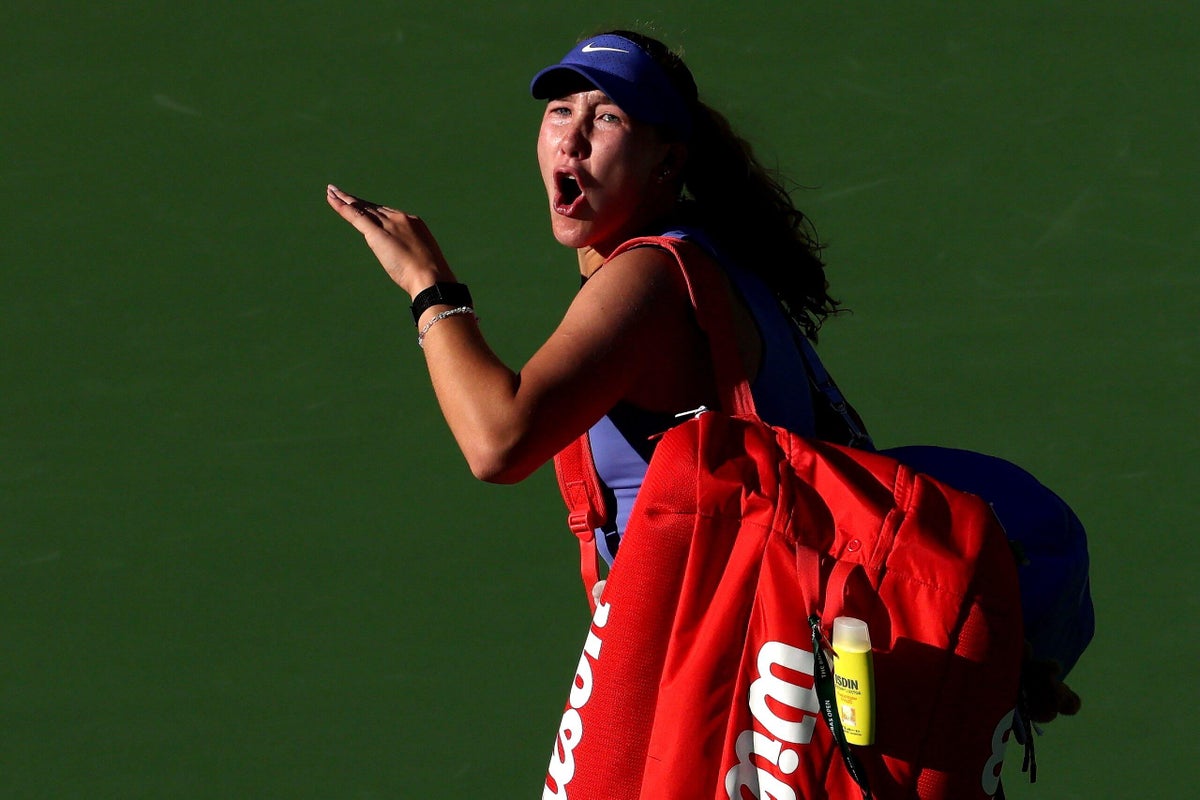
Just under 12 months after she walked out of Stadium 1 with the BNP Paribas Open trophy, Andreeva walked out of it gesturing to the crowd and appearing to say “f— you all, f— you all,” to either her box or the spectators, some of whom booed her off.
An inspired Kateřina Siniaková, and the pressure of defending a title, sent Andreeva home from the Coachella Valley with a 4-6, 7-6(5), 6-3 ticket.
“I’m not really proud of how I managed it. I’m not really proud of how I handled it in the end,” Andreeva said in a news conference.
“Those are the things that really need to work on soon. I don’t know. Not in the future but whenever I get the chance.”
Andreeva is 18, and has all the time she could possibly need to address how she manages tight losses against players up and down the rankings, which have as of late brought self-flagellation, tears and racket smashes. In the short term, her challenge is managing the pressure dynamics of a tennis match, which flip and shift in sometimes hard-to-see ways.
— wtay (@wtaclayy) March 9, 2026
In one, Andreeva showed toughness by coming from a 0-3, double-break deficit in the first set to win it 6-4. In another, the expectations that come with being a favorite — especially against Siniaková, a world No. 1 in doubles but ranked outside the top 40 — appeared to overwhelm her, as a match in which both players were tight wore on.
In a second set that lasted 72 minutes, Andreeva recovered from being broken at 4-4 by breaking Siniaková to love in the very next game, swinging as freely as she did all match — while behind and not expected to take the set.
Come the tiebreak, the players exchanged mini-breaks before Andreeva missed a swing volley on top of the net with Siniaková holding set point. She flung her racket to the ground before smashing it during the changeover and asking her team, including coach Conchita Martinez, to leave the court.
The third set followed a similar pattern, with a back-and-forth of breaks followed by another for Siniaková. It was with the Czech serving for the match that Andreeva’s aggressive tennis appeared again. She hammered her groundstrokes. She changed direction. She shot for the lines and hit them. Released from the pressure she had felt for most of the match as its possible end drew near, Andreeva could play the kind of tennis that carried her to the winner’s podium a year ago, in a stunning win against Aryna Sabalenka.
Doing that as a favorite is another question. When players defend titles or compile winning streaks, a sense of inevitability can be attached to them. But in tennis, a sport without a clock, the player who is ahead and carrying the weight of expectation cannot just hole up and defend. They have to keep doing what they did before, reaching the pinnacle again and again.
“I knew the pressure was on her. I was trying to enjoy it, because finally I was on the other side when I have nothing to lose,” Siniaková said in an interview with Tennis Channel.
“She’s an amazing player. You need to play long rallies, you need to do it on your own.”
For Andreeva, the speed and steepness of ascent have brought a level of expectation to which her match management appears yet to catch up. Since her two WTA 1000 titles this time last year, she has reached one semifinal and eight quarterfinals, losing in seven of them.
It was last year’s French Open, during which she played a French underdog in Loïs Boisson and lost despite a 5-3 first-set lead, that first showed how hard pressure can be to handle.
That was a particular situation. Playing a French player on Court Philippe-Chatrier is one of the toughest assignments in the sport; as Boisson raised her level, Andreeva’s rising annoyance, which included smashing a ball into the upper reaches of the stadium and telling a member of her box to leave, led the crowd to be more hostile. Plenty of tennis players down the years can relate to that.
But since then, other, more innocuous defeats — and even some in-match situations that are close to neutral — have left her hitting her racket against her legs or in tears mid-point.
Last month’s Dubai Tennis Championships title defense ended in similar circumstances against Amanda Anisimova, with Andreeva sobbing at her chair and Anisimova, who has gone on her own journey of decoupling her sense of self from the sport that she plays, expressing sympathy in her on-court interview.
Ahead of this tournament, Andreeva said in a news conference that she was aware of how pressure and expectations change with status.
“I was worried about defending points in Dubai since Roland Garros,” she said.
“So, you know, I was thinking about that a lot, but then actually when I came to Dubai, the only thing I felt is excitement of being there again, of feeling new emotions as being on the tournament as a defending champion.”
The same was true initially in the Coachella Valley, with a 6-0, 6-0 dismissal of Solana Sierra opening her tournament. But against Siniaková, she created 26 break points and converted seven, and made twice as many unforced errors as winners. It was just that kind of match, to a degree — Siniaková made plenty of errors of her own and looked to be hampered by an injury — but most striking was the way Andreeva’s convictions wavered with whether she was ahead or behind.
Her forehand squash shot is a remarkable defensive resource when she is using it as a foil to her potent topspin forehand as part of the powerful and probing tennis she produces when she is playing at her best. But against Siniaková, she used it too frequently, looking unable to trust her extreme full Western grip (the same one Świątek and Coco Gauff use) despite its being the one that brought her so much success last year. This is pressure in tennis. It works on even the things players trust most.
The end was ultimately ignominious. A Siniaková net cord flopped over and bounced twice on Andreeva’s side on match point. Siniaková apologized. Andreeva flung her racket. They shook hands. And as Siniaková showed emotion of her own in the joy of vanquishing such a favorite, Andreeva started her walk out of the stadium that would end in cursing and acrimony.