“What I’m just getting tired [of] a little bit is to get that target on my back all the time,” he reiterated Saturday, smiling.
Alcaraz felt that bullseye weighing heavier than ever Saturday, in the tournament’s semifinals. He was both facing a “Roger Federer” — Daniil Medvedev playing some of his most ferocious tennis in years — and just plain tired.
Alcaraz arrived on Stadium 1 16-0 on the year, with an Australian Open title, the record as the youngest man to complete the career Grand Slam and a Qatar Open title in the bank and miles on the match court in his legs. The searing heat of the Coachella Valley wasn’t exactly restorative.
The combination of Medvedev’s heightened aggressiveness and Alcaraz’s trace fatigue spelled vengeance for the Russian, who beat the top-ranked man 6-3, 7-6(3), after losing to the Spaniard in back-to-back BNP Paribas Open finals in 2023 and 2024.
“It’s an amazing feeling to beat someone like Carlos, No. 1 in the world,” Medvedev said.
“In a way, when you play him, Jannik, Novak, doesn’t matter the ranking. It’s just a great feeling to play them. And to beat them, of course, is even better.”
While Alcaraz took his first loss of the season, Medvedev will play his first ATP Masters 1000 final in two years Sunday against Jannik Sinner, who beat Alexander Zverev in a straightforward, 6-2, 6-4 semifinal earlier.
With the win — his first over Alcaraz since the 2023 U.S. Open semifinals — world No. 11 Medvedev also returns to the top 10 for the first time since July.
Medvedev earned his way back with a performance that blended his vintage hard-court mastery with an all-out attack, and this was no sudden rise of level. The 30-year-old is in the midst of something of a renaissance at the start of 2026. He carries a nine-match win streak into Sunday’s final, and he won the Brisbane International in January in Australia before picking up another title at the Dubai Tennis Championships earlier this month.
The latter, a walk-over win in the final against Tallon Griekspoor, meant he was stuck in the city for several days, due to the United States and Israeli strikes on Iran and retaliatory strikes by Iran on the United Arab Emirates and other neighboring Middle East nations.
If there were any ripple effects on his tennis from the ordeal, they haven’t shown in Indian Wells.
“Since the start of the match until the end of the match, he was playing unreal,” Alcaraz said.
“I have never seen, to be honest, Daniil playing like this.”
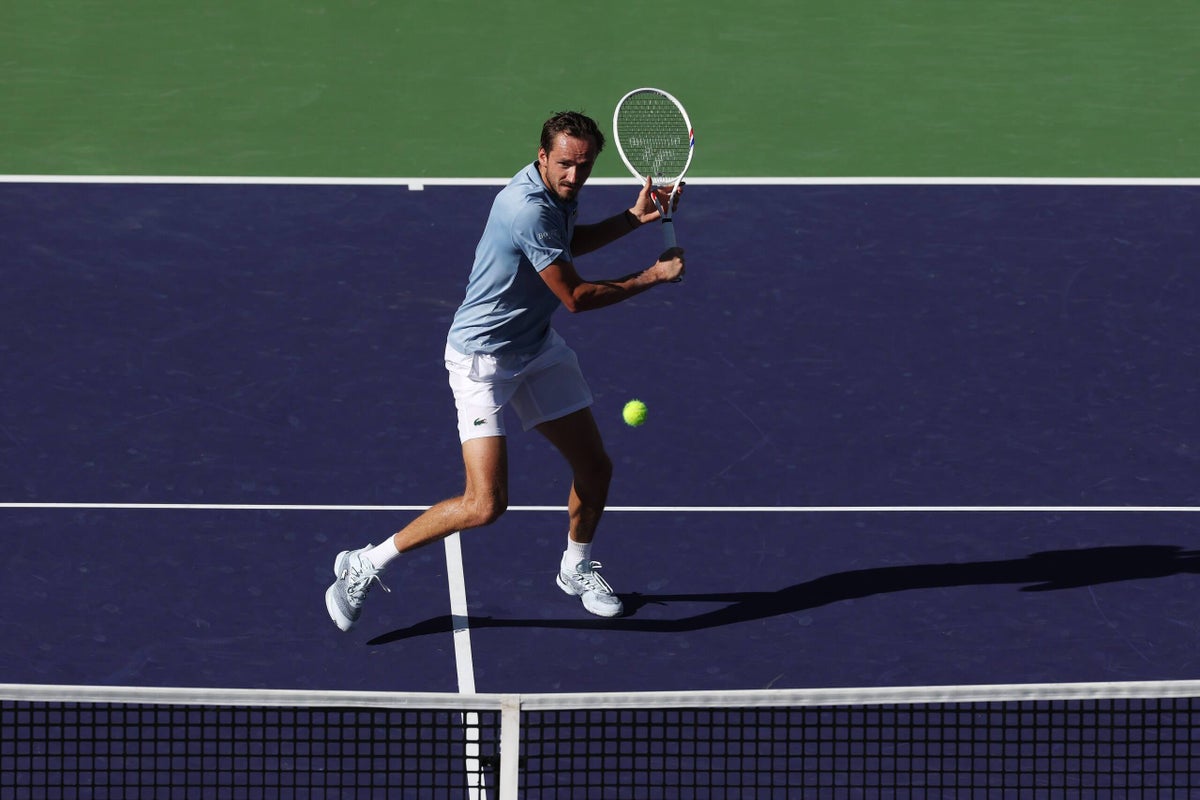
Medvedev was on the offensive from the start and controlled the match from end to end Saturday, taking advantage of the quick court and hot conditions to get the most out of his big serve and flat power. Alcaraz wasn’t as sharp as usual at the net and just a hair slower in his reaction time at the baseline, but that was partly because Medvedev never gave him a chance to breathe.
The 30-year-old played inside the baseline much more than he usually does. He was in attack for 30 percent of the match compared to Alcaraz’s 22 percent, according to Tennis Data Innovations. He won 74 percent of his second-serve points, up from a 52-week average of 50 percent, as well as 43.5 percent of his second-serve return points.
“It always has to be a balance, because I did try a bit in my career at one point to be, let’s call it overaggressive, and it was not good,” Medvedev said.
“It was spending too much energy, was not my style of playing, and I was getting crazy, breaking racquets, et cetera. I’m not talking about last year. It’s not exactly the case last year what I was trying to do, but in general.”
“Right now, I’m in confidence, and when I’m in confidence, I always said I feel like I’m an aggressive player, especially on my serve.”
His constant pressure made problem solving difficult. Alcaraz tried to serve and volley. He tried pulling the generally net-avoidant Medvedev in with drop shots. On Saturday, Medvedev found an answer more often than not. Alcaraz quickly fell into a 4-1 hole and didn’t have a break point in the first set.
“I knew at the beginning that he was going to play aggressive, but how, the way he did it, surprised me a lot,” Alcaraz said.
“Because he didn’t miss any — or he didn’t miss as much as I expected. He was playing aggressive, and he didn’t even miss.”
That’s a trend lately for the lanky Russian. He has breezed through his draw without dropping a set, including dispatching defending champion Jack Draper in the quarterfinals.
There was a small controversy in that match when Medvedev requested a video review of Draper making a shrugging motion mid-point. He was successful, even though he and Draper had continued to play the point out, and Medvedev requested a review only after he sent a backhand into the net.
That hiccup rolled right off of him, as everything seems to these days.
“I’m just trying my best, and sometimes my best can be low, as we saw, and sometimes it can be very high,” he said. “When it’s very high, I’m very happy, and to have a win like is a great feeling.”
Medvedev is now through to his biggest final in two years, where he’ll test the limits of his confidence and newfound aggressiveness against a man who knows a thing or two about keeping an opponent under constant pressure.