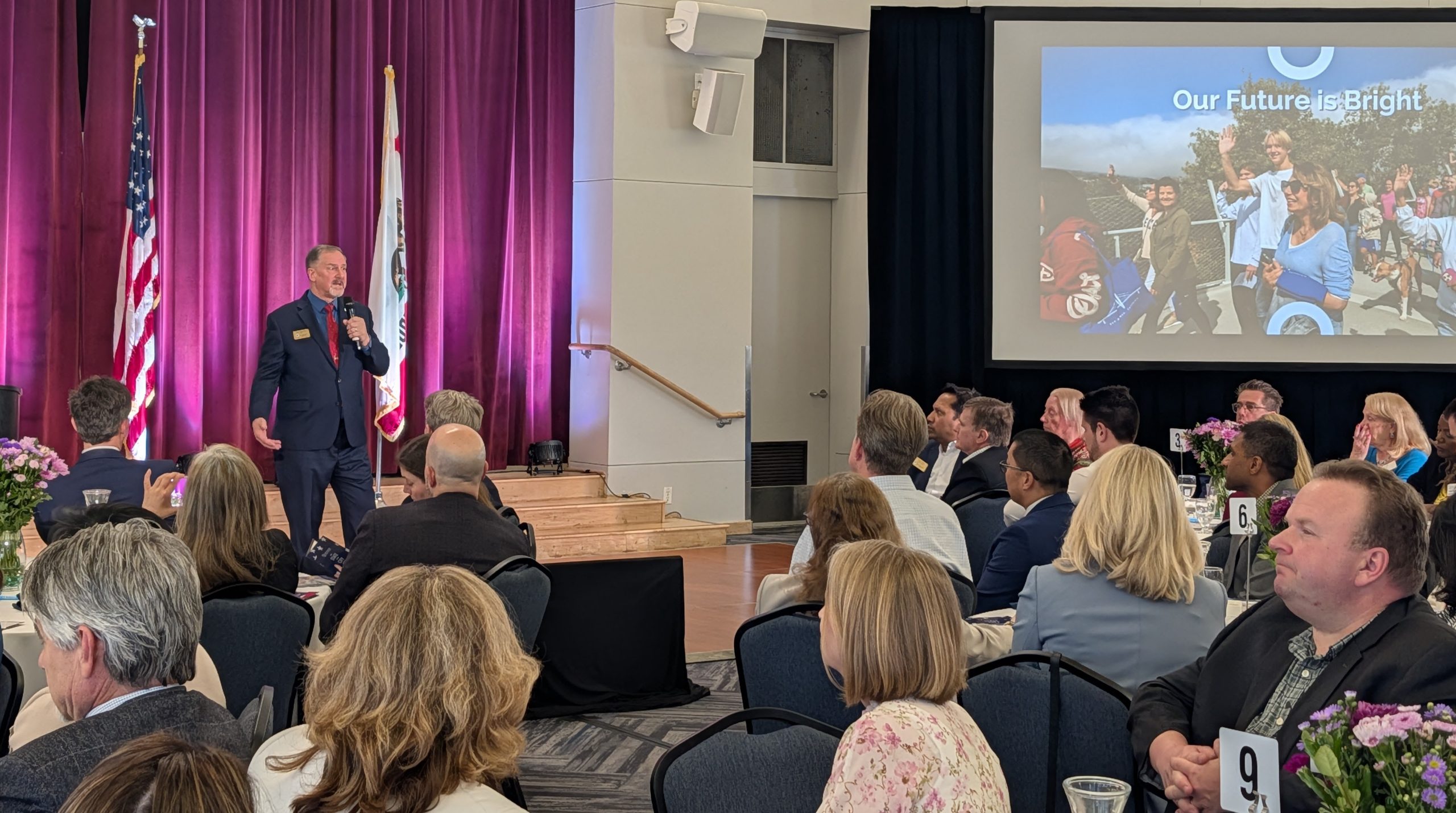
The new Iron Horse trail overcrossing, ongoing redevelopment of Bishop Ranch, earthquakes and the city’s overall quality of life were among the major topics at this month’s State of the City event in San Ramon, in which first-term mayor Mark Armstrong also opened up about his own background and move to the city.
Dozens of community members, elected officials, and local business owners and leaders gathered at the San Ramon Community Center on March 4 for Armstrong’s second time providing the annual speech to his constituents as mayor after his election to the position in 2024.
Armstrong began the speech with a quote from Innovation Tri-Valley CEO Katie Marcel during a conversation earlier in the event, in which she said she “can’t wait to see what’s shaking in San Ramon” – a nod to the city’s monthslong earthquake swarm – before providing details about how he came to be a longtime resident of the city and ultimately elected to office.
“I’m going to talk to you from a perspective not just as a mayor, but one of your neighbors,” Armstrong said.
Following his retirement from the U.S. Army in 2004, Armstrong – a Peninsula native – began looking toward next steps close to his hometown after being stationed in Germany, ultimately landing a job at Camp Parks.
“So then I started asking, ‘where’s a good place to live nearby?’ And they said San Ramon,” Armstrong said. “Everyone was saying San Ramon. I grew up in Palo Alto. I had no idea where San Ramon – I didn’t even know where Camp Parks was – but where is San Ramon, and why is everyone talking about it? And they were telling me about what a great city it was, safe city, beautiful city, great schools, things like that.”
A father of four, Armstrong was ultimately won over by San Ramon’s reputation as a “great place to raise kids” and the San Ramon Valley Unified School District’s high rankings as his family set down roots in the city, going on to become a grandfather and elected official.
“Later on in my time on the City Council, same sort of thing – I could go into different community events, different cultural events, interacting with people, Scouts, walking the dog, all sorts of times interacting and hearing about the things that are important to people,” Armstrong said.
The features that draw residents to San Ramon represent the city’s “lived values” according to Armstrong, including public safety, quality schools, recreation opportunities and open spaces, community connections, and “thoughtful, balanced growth.”
“It’s the active lifestyle; it’s the outdoor activities; it’s the fun things you can do at the park with the kids; it’s our safe city and great schools and things like that,” Armstrong said.
One project that symbolizes those values, Armstrong said, is the long-awaited Iron Horse Trail overcrossing at Bollinger Canyon Road that was completed and opened to the public last year.
“With this new bridge, it’s been able to activate the transportation corridor that connects our region, connects multiple cities, connects the north of the south part of the city here on the west side, and reduces a lot of that safety concern that we’ve had,” Armstrong said.
Armstrong went on to discuss how those community values guide the council’s strategic goals, and in turn, how those goals guide the governing body’s decisions and function as a “work plan” for the city manager.
“These are not just talking points,” Armstrong said. “This is really important to me, and it’s important to you, and so that’s what we focus on.”
Among those top priorities is public safety, and specifically earthquake preparedness, which was the topic of a much-anticipated town hall discussion the previous week that drew hundreds of residents who have been rocked by a slew of earthquakes as intense as magnitude 4.2.
While the growing city continues to attract new families, Armstrong also emphasized the importance of addressing the needs of its range of communities, particularly seniors, who are now the fastest growing population in San Ramon.
One need that extends throughout all demographics of present and future residents of the city is housing, with the city tasked with planning and progressing on more than 5,000 new housing units by 2031.
Armstrong reiterated that a majority of those units are set to be in the expanding city core, with multiple projects at various stages of development in Bishop Ranch as developers and city officials seek to transform the sprawling office park into a centralized, mixed-use downtown neighborhood.
Attracting new businesses and supporting existing ones is also a key component of that plan, Armstrong said.
“We’ve had a lot of ribbon-cuttings lately, new restaurants and retail, and non-retail, and some of our shopping centers have been going through revitalization, which is really exciting to see,” Armstrong said.
“And what we’re doing from the city perspective to help make all this happen is we’re creating that great quality of life, creating the environment where businesses can thrive and operate, where it’s safe for our businesses to operate, for the shoppers to shop, and for the families of local workers to be able to live here in San Ramon,” he continued.
But the top challenge for the city during Armstrong’s previous term on the City Council – in which he served as vice mayor – and in his current term as mayor has been its budget deficit, which led to drastic cuts across all departments in 2024 as well as the passage of Measure N, which raised the city’s sales tax rates by 1%.
Despite the increase in funds from the sales tax measure, Armstrong emphasized that the city government is committed to “living within our means.” That means no new positions or programs without trade-offs, no debt spending, and no “unsustainable commitments” amid ongoing work to reduce and eliminate the city’s structural deficit.
“We’re on track right now to bring in about $13.5 million of additional revenue, and that’s good news, because that’s allowed us to restore some of the things we cut in the previous budget,” Armstrong said. “And probably more importantly, we’ve been able to maintain a lot of those essential services and programs that you said are so important to you.”
Armstrong concluded that “our future is bright,” thanks not only to efforts by the city government and staff but of its volunteers and engaged community members.
“Thank you for being a part of all that we do,” Armstrong said. “What makes San Ramon such a great city is because of what you value, that you’ve communicated to us. It’s your involvement, your leadership, your participation in different community events that makes this such a great city. It is not just a great city, but it’s a city of neighbors, and I’m part of that neighborhood as well.”