–>
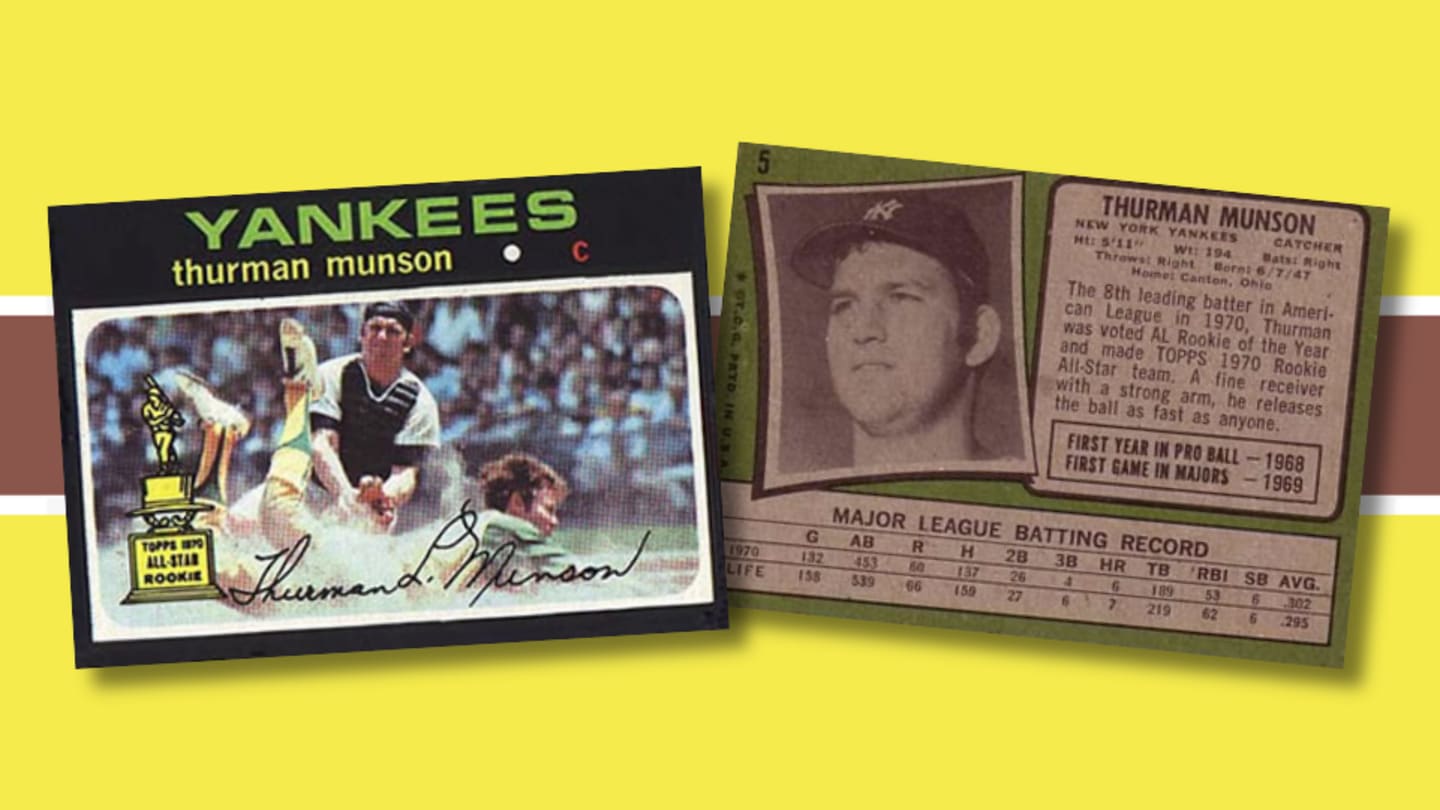
What happens when you combine a Yankee legend with a landscape layout, a gigantic All-Star Rookie trophy, a headfirst slide, and a bang-bang play at the plate? Only good things, obviously. And such was exactly the case with the 1971 Topps All-Star Rookie card. At the same time, a keen eye, a bit of research, and a healthy dose of Hobby history reveal even more about the card that’s great.
<!–qv q:id=5n q:key=vcaa:
Signature Silhouette
–>
Signature Silhouette
<!–qv q:id=5q q:key=vcaa:
RELATED: The Five Essential Baseball Cards of 1971 Topps
–>
RELATED: The Five Essential Baseball Cards of 1971 Topps
<!–qv q:id=64 q:key=vcaa:
Look quickly at Thurman Munson's facsimile signature, and it's possible all you'll notice is how much more legible it is that most of what passes for autos on today's cards. And if you're not a die-hard Yankee fan or member of the Society for American Baseball Research, good chance you'll think to yourself, "Oh, I didn't know his middle initial was L. Wonder what it stands for." (Answer: Lee.) Look longer, however, and you'll see that the signature actually matches the silhouette of the sliding player remarkably well. The initial "Th" correspond to the legs in the air, the capitalized "L" and "M" in the middle match up with the raised shoulders and head. And finally, the "unson" at the end follows the baserunner's outstretched arms. Not saying it's a perfect match but it sure ain't bad either.
–>
Look quickly at Thurman Munson’s facsimile signature, and it’s possible all you’ll notice is how much more legible it is that most of what passes for autos on today’s cards. And if you’re not a die-hard Yankee fan or member of the Society for American Baseball Research, good chance you’ll think to yourself, “Oh, I didn’t know his middle initial was L. Wonder what it stands for.” (Answer: Lee.) Look longer, however, and you’ll see that the signature actually matches the silhouette of the sliding player remarkably well. The initial “Th” correspond to the legs in the air, the capitalized “L” and “M” in the middle match up with the raised shoulders and head. And finally, the “unson” at the end follows the baserunner’s outstretched arms. Not saying it’s a perfect match but it sure ain’t bad either.
<!–qv q:id=67 q:key=vcaa:
Trailblazing Baserunner
–>
Trailblazing Baserunner

<!–qv q:id=6l q:key=vcaa:
Bruce Markusen at the National Baseball Hall of Fame and Museum and others have identified the sliding baserunner on the card as Oakland pitcher Chuck Dobson, who notched double-digit victories for the club five straight years from 1967 to 1971. Markusen also noted that in 1968 Dobson and teammate Reggie Jackson became major league baseball's first pair of regular roommates to cross racial lines.
–>
Bruce Markusen at the National Baseball Hall of Fame and Museum and others have identified the sliding baserunner on the card as Oakland pitcher Chuck Dobson, who notched double-digit victories for the club five straight years from 1967 to 1971. Markusen also noted that in 1968 Dobson and teammate Reggie Jackson became major league baseball’s first pair of regular roommates to cross racial lines.
<!–qv q:id=6o q:key=vcaa:
Out or Safe?
–>
Out or Safe?

<!–qv q:id=72 q:key=vcaa:
Immediately following the All-Star Break, the A's and Yankees kicked off their second half with a Thursday doubleheader at Yankee Stadium. The A's thoroughly dominated, winning the game 8-2 behind a complete game by the aforementioned Chuck Dobson. But what about the play at the plate? How did it happen and what was the result? This is fairly easy to pin down since Dobson was on the bases only once that day.
–>
Immediately following the All-Star Break, the A’s and Yankees kicked off their second half with a Thursday doubleheader at Yankee Stadium. The A’s thoroughly dominated, winning the game 8-2 behind a complete game by the aforementioned Chuck Dobson. But what about the play at the plate? How did it happen and what was the result? This is fairly easy to pin down since Dobson was on the bases only once that day.
<!–qv q:id=75 q:key=vcaa:
With two outs in the top of the fourth and runners on first and third, Dobson successfully bunted for a base hit, scoring Tommy Davis and advancing Frank Fernandez to second. Bert Campaneris followed with a single of his own, plating Fernandez and moving Dobson into scoring position. The next batter, Joe Rudi, followed with a single of his own, sending Dobson streaking toward home plate. Yankees right fielder Curt Blefary fired the ball to Munson, no cut-off needed, but Dobson was able to slap home plate with a hand just before Munson could apply the tag.
–>
With two outs in the top of the fourth and runners on first and third, Dobson successfully bunted for a base hit, scoring Tommy Davis and advancing Frank Fernandez to second. Bert Campaneris followed with a single of his own, plating Fernandez and moving Dobson into scoring position. The next batter, Joe Rudi, followed with a single of his own, sending Dobson streaking toward home plate. Yankees right fielder Curt Blefary fired the ball to Munson, no cut-off needed, but Dobson was able to slap home plate with a hand just before Munson could apply the tag.
<!–qv q:id=78 q:key=vcaa:
Making the Call
–>
Making the Call

<!–qv q:id=7m q:key=vcaa:
Though he doesn't make it onto the frame of the card, calling Dobson safe at home was veteran umpire Bill Haller of Joliet, Illinois. Haller made a bit of history nearly two years to the day after the call, setting up behind the plate in Detroit when the Tigers catcher was none other than his brother Tom! Whether the Detroit pitchers were a bit wild that day or Haller was trying extra hard not to show any brotherly bias, opposing batters walked seven times as Detroit lost the game 1-0.
–>
Though he doesn’t make it onto the frame of the card, calling Dobson safe at home was veteran umpire Bill Haller of Joliet, Illinois. Haller made a bit of history nearly two years to the day after the call, setting up behind the plate in Detroit when the Tigers catcher was none other than his brother Tom! Whether the Detroit pitchers were a bit wild that day or Haller was trying extra hard not to show any brotherly bias, opposing batters walked seven times as Detroit lost the game 1-0.
<!–qv q:id=7p q:key=vcaa:
Something in common with the 1952 Mantle
–>
Something in common with the 1952 Mantle
<!–qv q:id=7s q:key=vcaa:
RELATED: The Five Essential Baseball Cards of Mickey Mantle
–>
RELATED: The Five Essential Baseball Cards of Mickey Mantle

<!–qv q:id=86 q:key=vcaa:
Besides both players being legendary members of the Bronx Bombers, there is a common thread connecting the 1971 Topps Thurman Munson and 1952 Topps Mickey Mantle. The two cards are among the handful of second-year cards in Hobby history far more famous than their rookie card counterparts.
–>
Besides both players being legendary members of the Bronx Bombers, there is a common thread connecting the 1971 Topps Thurman Munson and 1952 Topps Mickey Mantle. The two cards are among the handful of second-year cards in Hobby history far more famous than their rookie card counterparts.
 Add us as a preferred source on Google