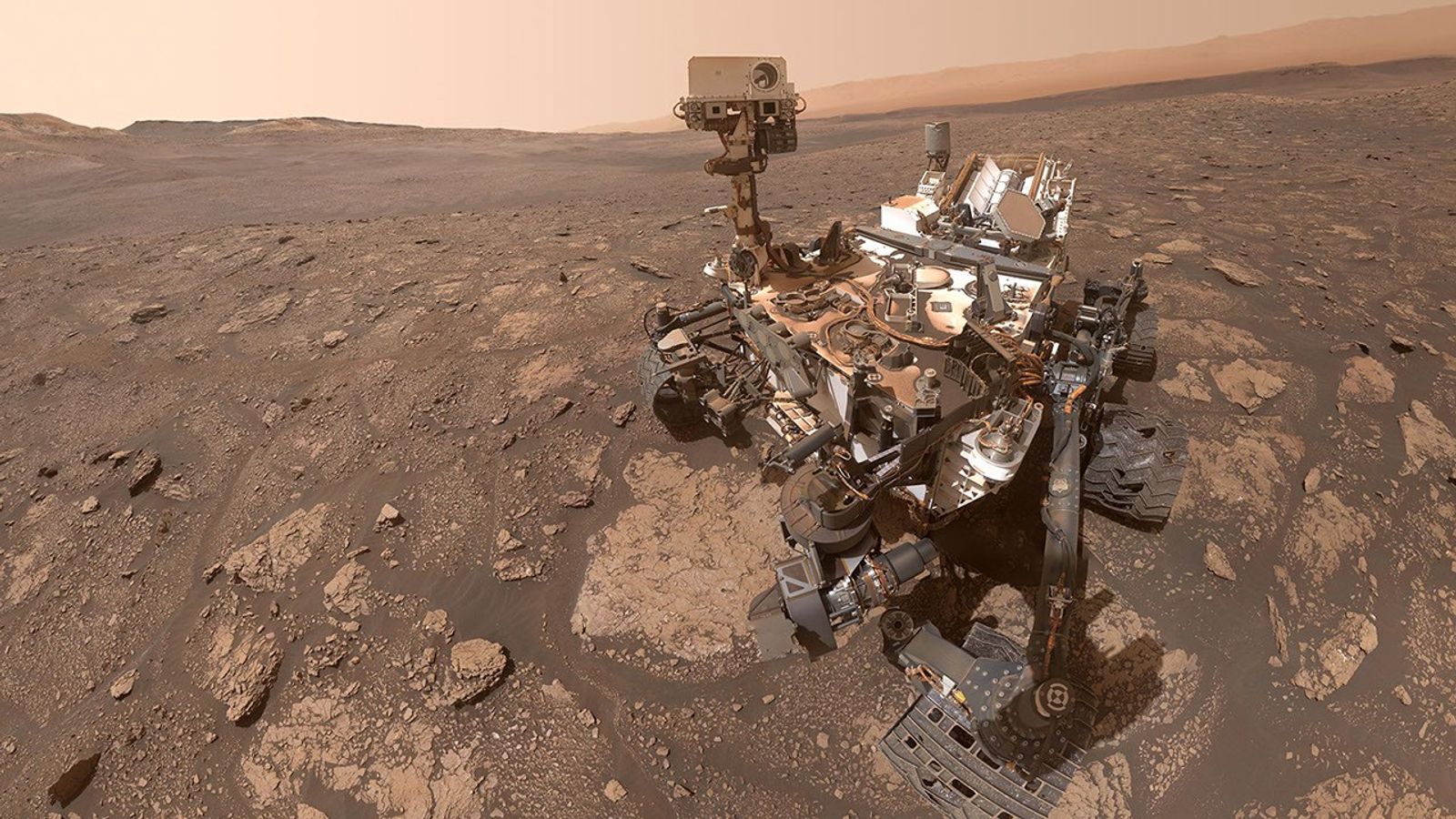
Scientists have no way of knowing whether these organic molecules were created by biologic or geologic processes — either path is possible — but their discovery renewed confirmation that ancient Mars had the right chemistry to support life. What’s more, the molecules join a growing list of compounds known to be preserved in rocks even after billions of years of exposure on Mars to radiation, which can break down these molecules over time.
The findings are detailed in a new paper published Tuesday in Nature Communications.
The rock sample, nicknamed “Mary Anning 3” after an English fossil collector and paleontologist, was collected on a part of Mount Sharp covered by lakes and streams billions of years ago. This oasis surged and dried up multiple times in the planet’s ancient past, eventually enriching the area with clay minerals, which are especially good at preserving organic compounds — carbon-containing molecules that are the building blocks of life and are found throughout the solar system.
Among the newly identified molecules is a nitrogen heterocycle, a ring of carbon atoms that includes nitrogen. This kind of molecular structure is considered a predecessor to RNA and DNA, two nucleic acids that are key to genetic information.
“That detection is pretty profound because these structures can be chemical precursors to more complex nitrogen-bearing molecules,” said the paper’s lead author, Amy Williams of the University of Florida in Gainesville. “Nitrogen heterorcycles have never been found before on the Martian surface or confirmed in Martian meteorites.”
Another exciting discovery was benzothiophene, a carbon- and sulfur-bearing molecule that’s been found in many meteorites. These meteorites, along with the organic molecules within them, are thought by some scientists to have seeded prebiotic chemistry across the early solar system.
The new paper complements last year’s finding of the largest organic molecules ever discovered on Mars: long-chain hydrocarbons, including decane, undecane, and dodecane.
“This is Curiosity and our team at their best. It took dozens of scientists and engineers to locate this site, drill the sample, and make these discoveries with our awesome robot,” said the mission’s project scientist, Ashwin Vasavada of NASA’s Jet Propulsion Laboratory in Southern California. “This collection of organic molecules once again increases the prospect that Mars offered a home for life in the ancient past.”
Both sets of findings were made with a sophisticated minilab called Sample Analysis at Mars (SAM), located in Curiosity’s belly. A drill on the end of the rover’s robotic arm pulverizes a carefully selected rock sample into powder and then trickles it into SAM, where a high-temperature oven heats the material, releasing gases that instruments in the lab analyze to reveal the rock’s composition.
In addition, SAM can perform “wet chemistry,” dropping samples into a small cup of solvent. The resulting reactions can break apart larger molecules that would be difficult to detect and identify otherwise. While the instrument has several such cups, only two contain tetramethylammonium hydroxide (TMAH), a powerful solution reserved for the highest-value samples. The Mary Anning 3 sample was the first to be exposed to TMAH.
To verify TMAH’s reactions with otherworldly materials, the paper’s authors also tested the technique on Earth with a piece of the Murchison meteorite, one of the most studied meteorites of all time. More than 4 billion years old, Murchison contains organic molecules that were seeded throughout the early solar system. A Murchison sample exposed to TMAH was found to break much larger molecules into some of the ones seen in Mary Anning 3, including benzothiophene. That result verifies that the Martian molecules found in Mary Anning 3 could have been generated from the breakdown of even more complex compounds relevant to life.
Curiosity recently used its second and final TMAH cup while exploring weblike boxwork ridges, which were formed by ancient groundwater. The mission team will be analyzing those results for a future peer-reviewed paper.
Built by NASA’s Goddard Space Flight Center in Greenbelt, Maryland, SAM is based on larger, commercial-grade lab instruments. Getting such complex equipment into the rover required engineers to dramatically shrink it down and develop a way for it to run on less power. Scientists had to learn how to heat up SAM’s oven more slowly over longer periods in order to conduct some of these experiments.
“It was a feat just figuring out how to conduct this kind of chemistry for the first time on Mars,” said Charles Malespin, the instrument’s principal investigator at NASA Goddard and a study coauthor. “But now that we’ve had some practice, we’re prepared to run similar experiments on future missions.”
In fact, NASA Goddard has provided several components, including the mass spectrometer, for a next-generation version of SAM, called the Mars Organic Molecular Analyzer, for ESA’s (European Space Agency) Rosalind Franklin Mars rover. A similar instrument, the Dragonfly Mass Spectrometer, will explore Saturn’s moon Titan on NASA’s Dragonfly rotorcraft. Both instruments will be able to perform wet chemistry with the TMAH solvent.
Curiosity was built by JPL, which is managed by Caltech in Pasadena, California. JPL leads the mission on behalf of NASA’s Science Mission Directorate in Washington as part of NASA’s Mars Exploration Program portfolio.
To learn more about Curiosity, visit:
https://science.nasa.gov/mission/msl-curiosity
News Media Contacts
Andrew Good
Jet Propulsion Laboratory, Pasadena, Calif.
818-393-2433
andrew.c.good@jpl.nasa.gov
Karen Fox / Alana Johnson
NASA Headquarters, Washington
240-285-5155 / 202-672-4780
karen.c.fox@nasa.gov / alana.r.johnson@nasa.gov
2026-024