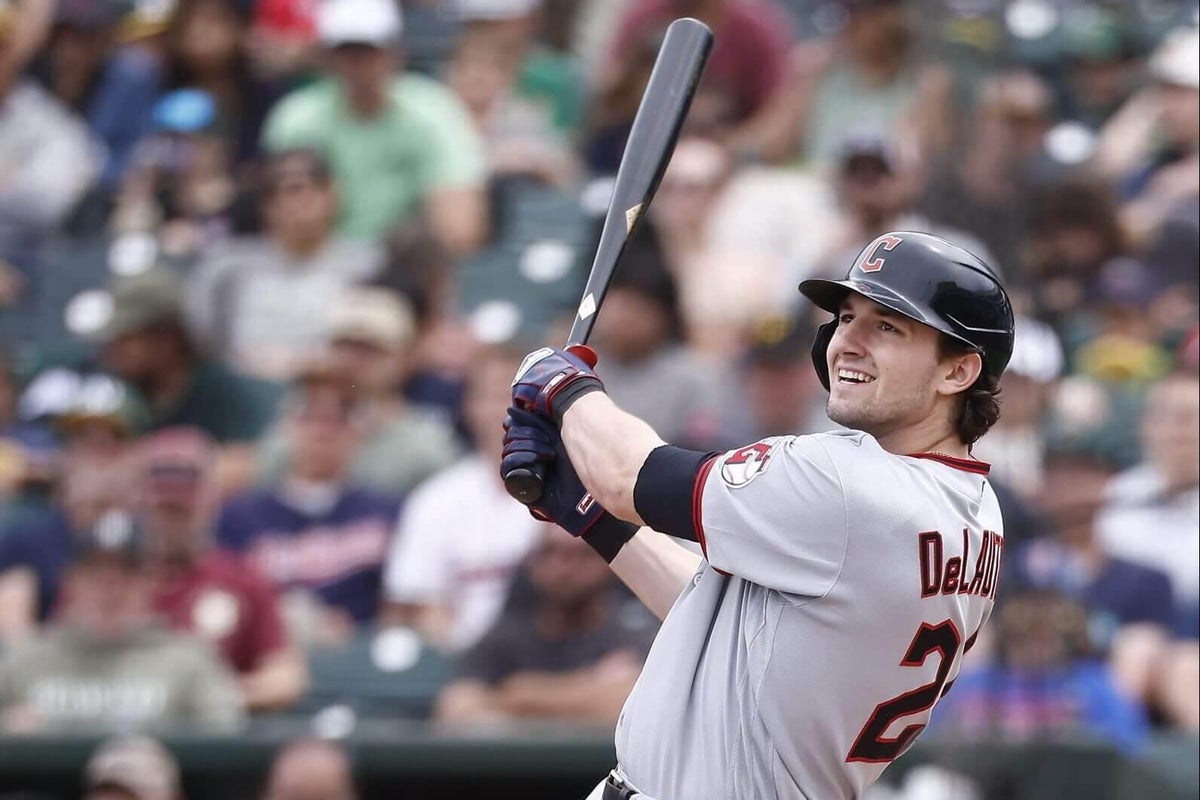
Chase DeLauter is Cleveland’s most impressive rookie hitter since …
… Al Rosen? Granted, it’s early-ish. If he sustains this, however, he’ll have a chance to claim the best rookie season by a Cleveland hitter in at least 75 years.
We’ll use OPS+ for this exercise as a way to balance the playing field. Brian Giles’ .827 OPS in 1997, for example, isn’t as noteworthy as Francisco Lindor’s .835 OPS in 2015, given that everyone was pummeling baseballs in the late ’90s and pitchers were silencing bats in the 2010s.
The best OPS+ figures by a Cleveland rookie (minimum 350 plate appearances):
|
Player
|
Year
|
OPS+
|
|---|---|---|
|
Hal Trosky |
1934 |
150 |
|
Al Rosen |
1950 |
145 |
|
Les Fleming |
1942 |
144 |
|
Earl Averill |
1929 |
136 |
|
Rocky Colavito |
1956 |
135 |
|
Joe Charboneau |
1980 |
129 |
|
Tyler Naquin |
2016 |
128 |
|
Al Luplow |
1962 |
126 |
|
Roy Foster |
1970 |
122 |
|
Francisco Lindor |
2015 |
121 |
|
Jody Gerut |
2003 |
120 |
DeLauter’s OPS+, as of Thursday morning, was 163.
Now, OPS+ isn’t everything. Hal Trosky totaled 89 extra-base hits, walked more than he struck out and produced a .330/.388/.598 slash line. Al Rosen led the American League with 37 homers and piled up 100 walks. Earl Averill flaunted a .332 average with 43 doubles and 13 triples. Joe Charboneau hit 23 homers, opened beer bottles with his eye socket and swallowed lit cigarettes and endured a penknife stabbing in Mexico City and won AL Rookie of the Year.
Sandy Alomar Jr. is the franchise’s most recent Rookie of the Year winner (1990), and he posted a 108 OPS+ that season, with a .290/.326/.418 slash line.
The best compliment we can pay DeLauter so far? He doesn’t seem like a rookie.
Hitting is about adjusting to how pitchers attack you. When you make sound swing decisions, you can execute those adjustments more swiftly. DeLauter “slumped” for a few weeks, but that stretch was tolerable because he drew a lot of walks and rarely struck out. That kept DeLauter from pressing and chasing and playing right into pitchers’ hands.
Jhonkensy Noel, for instance, never recovered once pitchers realized he would hack away at everything out of the zone. (His 49 percent chase rate last year proves that. DeLauter’s chase rate this season is 20 percent, which places him in the 95th percentile.) Resist the junk, spoil a few tough pitches on the edges of the strike zone, and you’ll eventually earn pitches to your liking and start hitting again. That’s what has happened with DeLauter, and it’s why this start to his rookie season has been so … un-rookie-like. He doesn’t just rank well among first-year players. He’s among the league leaders in average, on-base percentage, slugging percentage and doubles.
First seven games: 9-for-26, 5 HR, 1 BB, 7 K, .346/.370/.923
Next 18 games: 11-for-63, 0 HR, 12 BB, 5 K, .175/.303/.286
Next 10 games: 18-for-35, 1 HR, 5 BB, 3 K, .514/.593/.743
No one needed a three-run blast more than …
… Bo Naylor, who clobbered one in the seventh inning in the series finale against the Kansas City Royals. Entering play Thursday, among the 345 players with at least 50 plate appearances, here’s how Cleveland’s catchers had fared:
Austin Hedges: 26th in average, 68th in slugging
Naylor: 341st in average, 336th in slugging
Austin Hedges’ wRC+, by year
| Year | wRC+ |
|---|---|
|
2026 |
131 |
|
2025 |
51 |
|
2024 |
20 |
|
2023 |
24 |
|
2022 |
43 |
|
2021 |
42 |
|
2020 |
45 |
|
2019 |
48 |
|
2018 |
90 |
|
2017 |
69 |
A couple of weeks ago, Naylor’s beneath-the-surface metrics appeared encouraging enough to believe he’d snap out of his slumber, but those inputs have waned.
League-average slash line in 2026: .242/.321/.392
League-average slash line for catchers: .231/.303/.374
Hedges’ slash line in 2026: .311/.360/.467
Naylor’s slash line in 2026: .143/.200/.238
Hedges has essentially taken over behind the plate when the Guardians are facing a lefty starter or when Parker Messick is pitching for Cleveland. Cooper Ingle is healthy again at Triple A, and though he’s producing video game-like numbers (19-for-44 with 22 walks, good for a 1.445 OPS), the Guardians tend to err on the side of patience with young catchers until they feel they can trust them to guide a pitching staff. That said, Hedges would be a perfect mentor to any rookie catcher.
Steven Kwan has one multihit game …
… in the last three weeks. Nearly one quarter of his hits (seven of 29) came in the first five games of the season. Everything’s down — his bat speed, hard-hit rate, exit velocity — and he wasn’t exactly the model for those metrics before this season. There’s been an abundance of weak, harmless contact, and at some point, should it persist, it should spark some lineup reconstruction.
Steven Kwan’s hits breakdown
| 2024 | 2025 | 2026 | |
|---|---|---|---|
|
0-hit games |
28.9% |
31.4% |
42.9% |
|
1-hit games |
38.8% |
36.5% |
34.3% |
|
2-hit games |
21.5% |
24.4% |
20.0% |
|
3+ hit games |
10.7% |
7.7% |
2.9% |
Before he earned his promotion to the big leagues, Travis Bazzana made a concerted effort …
… to strike a balance between patience and passivity at the plate. He focused on driving outside pitches the other way, rather than taking them and waiting for the pitcher to toss something on the inner half that he could turn on and whack to right field.
He’s still drawing a bunch of walks in the majors, which, as with DeLauter, is a great way for any hitter, especially a rookie, to weather a cold spell.
It’s reminiscent of when Matt Blake, Cleveland’s pitching coordinator before the New York Yankees hired him to be their pitching coach, relayed to a Double-A kid named Shane Bieber that he should workshop a changeup. No, Bieber didn’t need another pitch to solve Eastern League hitters, but Cleveland’s pitching analysts figured it could behoove him to have that in his pocket for when he reached the big leagues.
Bazzana could reach base at a high clip in the minors just by standing at the plate and deciphering a pitch’s spin and direction. In the majors, though, pitchers will hunt your flaws and expose them until you prove you can adapt, so you might as well start preparing an attack plan. Bazzana described it as “finding this fine line between zone aggression and still having a great eye to not give in to stuff.”
“The problem-solving nature of Travis,” said Stephen Osterer, Cleveland’s vice president of player development, “it’s a nice little storyline part of this, where we want to see what he does against the best pitchers in the world and how they attack him and how he responds to that.
“Most hitters have a bit of that journey of, where is the line and what is the intent going into the box? He’s been a little bit more aggressive this year. … The cat-and-mouse game within a game and then over a course of games, he’s really good at playing that. I think he’s going to figure that out.”
After Cade Smith and Erik Sabrowski, the reliever Stephen Vogt should trust the most is …
…
…
… Tim Herrin? Colin Holderman? Someone in Columbus?
This continues to be an area of concern for the Guardians. They haven’t landed on a consistent arm to turn over a lead to Sabrowski and Smith. They desperately need Hunter Gaddis to get right. He’s throwing his slider 62 percent of the time, but his chase rate — his greatest strength the last couple of years — is down drastically. To throw a slider that often, a pitcher needs to be able to either throw it for strikes or give hitters a reason to flail at it out of the zone.
One option down below is Franco Aleman, whose performances might as well be pleas to Cleveland’s front office. Aleman has totaled 12 innings at Columbus this season, with 18 strikeouts, four walks, three hits allowed and a 0.00 ERA. Andrew Walters, another eventual candidate, hasn’t pitched in two weeks because of a viral infection. He’s expected to begin a new rehab assignment with Columbus in the coming days.