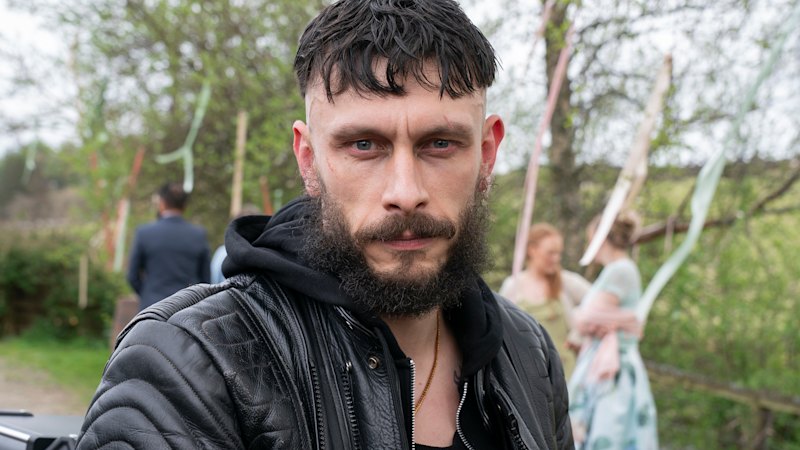
The 36-year-old Scot’s Edinburgh Fringe shows Monkey See Monkey Do and Baby Reindeer delved into his experience of sexual abuse. Both were folded into his critically acclaimed Netflix series, which unleashed those themes, and his exploration of his dark journey and recovery, like a cultural tornado.
“It’s the great debate, isn’t it, around art, whether it can exist outside the author, the whole ‘death of an author’ idea, and I think to a certain extent all work is autobiographical, even the stuff that’s really far removed, genre-wise, from the human existence,” Gadd says. “If we look at horror films, all the ones that are great successes are ones written from a place of what scares the author the most.
“All work is autobiographical to a certain extent, and I think something can be fictional and autobiographical [at the same time] to a certain degree. With Half Man, it is a purely fictional world, no characters are based on anyone whatsoever, but it borrows from themes … character traits I recognise and struggles that I have experience of.”
Half Man is the story of two men who grew up as brothers, despite not being related by blood, Niall Kennedy (Bell) and Ruben Pallister (Gadd). Niall is bookish, sensitive and thoughtful, bullied at school and gentle in nature. Ruben is, at least at first glance, the opposite: strong, violent and lacking in boundaries. He is also fiercely loyal to, and instinctively protective of, his younger brother.
In the sense that this is their story, the stunning creation of these two complex characters is as much a credit to Bell and Gadd as it is to Mitchell Robertson and Stuart Campbell, who play them as teenagers in the flashbacks that dominate the first half of the series.
An uncertain tension permeates the series, stretched taut by Gadd’s extraordinary writing and Alexandra Brodski and Eshref Reybrouck’s beautiful direction. But it is not long before we reach a violent breaking point, which unleashes a dark narrative journey that is challenging in almost every way. Across their lives, Niall and Ruben’s relationship is fractured and mutually destructive, shockingly violent and also, sometimes, heartbreaking. It is not an easy watch.
Filming the series was challenging, Gadd admits, not least because as the creator and showrunner, he would have to step out of excessively emotional moments and deal with the production. “When we yell ‘cut’, I have to immediately shift into a different mindset,” Gadd says.
“There are some scenes … when you have to gee yourself up to maybe go ballistic or lose your temper badly and shout and scream [and] at the end, your whole body’s trembling. Then the next day on set is actually even worse because adrenaline crashes are really very difficult. You can never fully sit in it too much, but that’s not to say it doesn’t stay in me.”
The inescapable horror of Niall and Ruben’s relationship, however, is that regardless of how dark and destructive it becomes, it is still a kind of love story. Even if the two men at the centre of that story have a deep, uncontrollable and damaging brotherly love for each other.
“I think a lot of people will say ‘Look, it’s about male violence. It’s about toxic masculinity’. They say all these things,” Gadd says. “But to me, it’s about two men struggling to love themselves and love one another. And it’s the struggle around the communication of love, and the disconnect that we feel between our emotions and our ability to articulate them, that is the heart of Half-Man.”
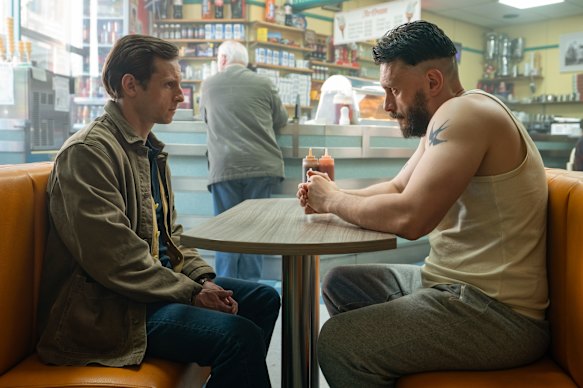
Complicating matters further is that Ruben is not, in every scenario, a terrible man. Indeed, his acts of generosity, and what is revealed about his capacity to forgive and even empathise, makes his tendency to excessive and horrific violence a tough algorithm to resolve.
“I never saw him as a source of evil, he did a lot of bad things, things that cannot be excused, but I saw him as someone who was fundamentally human, who didn’t have a childhood, who ran on a river of pain,” Gadd says. “Had things turned out differently, I think things would’ve been different. It’s complicated. I never wanted to write him as an inhuman force of psychosis or an inhuman force of just awful thing after awful thing.
“But I think a lot of people who use attack are very vulnerable, like a lot of men who adopt alpha traits, who are very aggressive,” Gadd adds. “At the heart of it, I think there is truth, huge vulnerability, [and] attack being the best form of defence. And I think that a lot of Ruben’s struggles are his inability to communicate the pain he’s feeling, or trying not to feel as disempowered as he has felt.”
Half Man will, inevitably, draw comparisons to Baby Reindeer. They are, of course, different. Half Man is fiction, even if it is dipped in the hot wax of a complex emotional palette drawn from Gadd’s life and his struggle to recover from abuse. And Baby Reindeer was a kind of polished-but-gritty television truth, born out of a comedy show that tapped Gadd’s darkest and most discomforting experiences.
“I was so unhappy 10 years ago, in fact, my decision to do Baby Reindeer was almost like a lifeline, like a last roll of the dice in terms of how do I escape these impossible pressures that I find in my life,” Gadd says. “But I think there’s still work to go, in a lot of ways. I still have my doubts and all these kinds of things and senses of loneliness and isolation and confusion about the future and worry about where I’m going and worry about this.
“It’s really hard, sometimes. And accepting that life might always be a bit confusing and difficult actually goes some way to bring in a sense of peace. But I look back on where I was 10 years ago, and I think it’s progress.”
Half Man also lands in a complicated cultural landscape of discussions about toxic masculinity, its connection to the political discourse, and newer, more dangerous trends such as “looksmaxxing” emerging in younger male peer groups. The curious footnote to it all is that Half Man is not a response to this cultural moment; it was written back in 2019 and, when Gadd moved on to Baby Reindeer, was left in a drawer.
“The show coming out now is almost serendipity,” Gadd says. “I wrote it, then paused it for four years to do Baby Reindeer, and then came back to it. And it just so happens that I’ve come back to it while this social media epidemic seems to be going on around the ‘manosphere’ and toxic masculinity.”
Outside of an Instagram account, Gadd does not have a substantial online presence, nor does he engage much on social media. “Even as I’m saying it, I don’t even really know what it is,” he says. “But I feel like the mistake that some people perhaps make is trying to join the two together. I never really set out [in Half-Man] to address socio-political themes. Because if I set out like a writer to be like ‘I want to answer this question’, then I feel like I’m not writing from the heart.
“What I hope Half Man does, in a similar way to what I hope Baby Reindeer does, is that it offers a window into lives of two broken men who have a real problem with expression and vulnerability. And then it’s for people, I suppose, to take what they need or what they think from that.
“Art in this day and age has this ability to slightly point the finger and spell it out a bit too clearly; you can almost feel the author saying, this show is about this, and you must feel this way about a certain thing. It just leads to art being too clear, and I think life’s not clear; art should mirror life and its lack of clarity.
“All I can say is I’ve gone on a journey to explore a complicated subject like male violence, male repression, male rage, only to end up at the end and realise, wow, it’s even more complicated than I thought it was.”
Half Man is now streaming on Stan (which is owned by Nine, the publisher of this masthead).