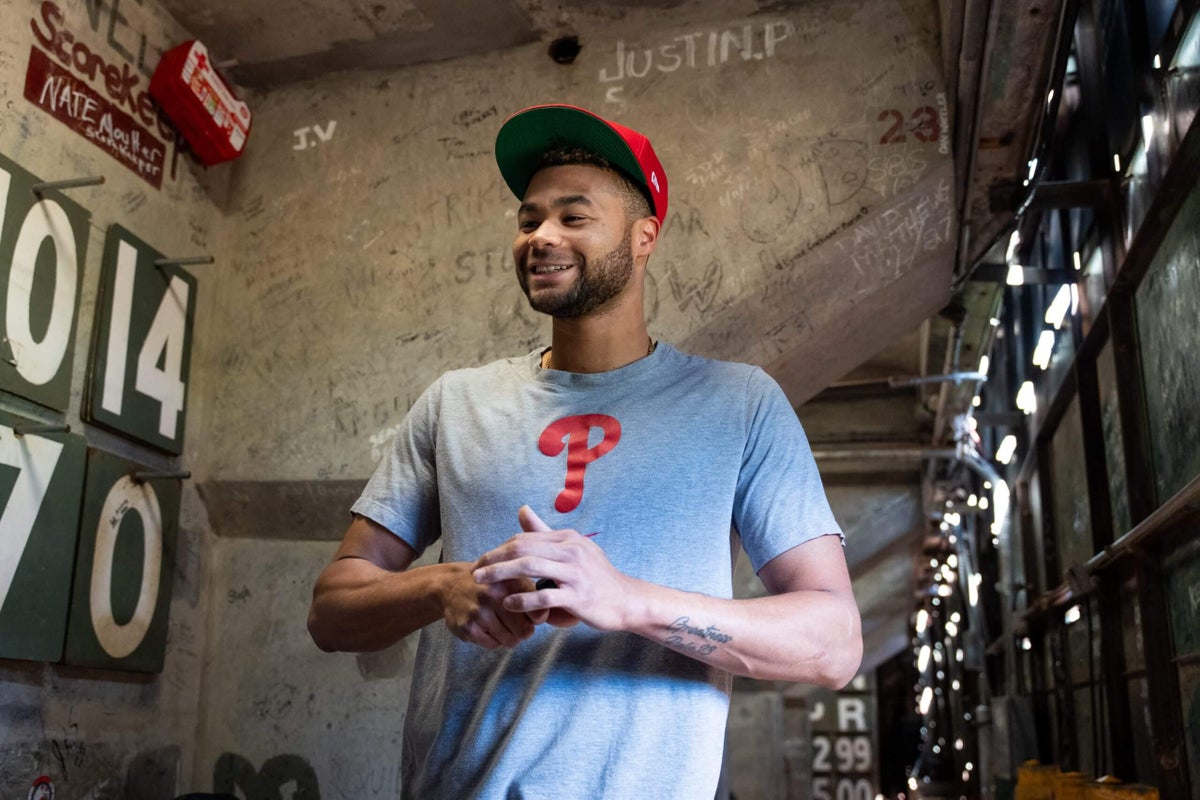
But as he walked, dwarfed by the Green Monster and surrounded by red seats, it wasn’t just about the moment. It was about remembering little ones when Crawford was 7 and 8 years old and trailing his father, former major leaguer Carl Crawford, around Fenway: the miniature Red Sox uniform he wore, walking on the field with his father, shagging balls with him — those moments, Crawford said, sealed his desire to play professional baseball.
“That’s when it hit me,” he said of walking to center, “I was a kid, running around here, playing. Little Justin would be screaming right now (if he knew).”
Big Justin, 22, wore a smile as he worked in the outfield, took batting practice and fielded questions from several media members about his memories at Fenway. It is fitting that Crawford considered his past, the days he toddled behind his father, in a ballpark that operates as a living museum. But now it is where his present lies as the Phillies center fielder whose big-league career is 37 games in the making.
Crawford has been about as predicted on offense this season: plenty of infield singles, not a whole lot of power, BABIP (batting average on balls in play) ranking 20th in the majors. He has swiped fewer bases (four) than one would expect, still figuring out stealing at the major-league level. He is hitting .056/.150/.056 against lefties, though Crawford said he feels comfortable against them. All in all, he has been effective in the lineup, slashing .271/.344/.390 with a .734 OPS.
His defense, however, has been shaky. The Phillies had a decision to make early in the offseason about whether they would seek an established center fielder and stick Crawford in left, or run with him in center — a position he wanted to play and improve on. They went with Crawford in center, with president of baseball operations Dave Dombrowski saying during the winter that they knew he was an unfinished product there. The club trusted he could grow.
That is still the refrain among Crawford’s coaches: He is developing. At best, his defense reflects that. At worst, it is harmful to the Phillies. While defensive statistics will fluctuate, Crawford has the worst Defensive Runs Saved in the majors (minus-8) and second-worst Outs Above Average (minus-three) among center fielders.
“He really hasn’t played that much center field,” interim manager Don Mattingly said. “He’s 22 years old. We feel he’s going to get better. He’ll continue to work. He’ll continue to improve. For us, it’s getting him to be as good as he can be. It doesn’t really matter what his numbers are — I mean, it matters, to a degree, but we just want to help him get better.”
Crawford said earlier in the season he felt hesitant on balls hit to shallow center that he likely could have tried to make a play on. Outfield coach Paco Figueroa noticed the same thing. The numbers back it up.
The Phillies have allowed a majors-worst .222 BABIP (14 hits) on fly balls and popups to center field, though that measure may not include all balls hit to shallow center. (Some may register as being caught by the second baseman or shortstop.) Eight of those hits were singles, of which the total average distance was 214 feet.
Figueroa has worked with Crawford on getting jumps on balls that might not even be hit to him. He said a ball could be hit to the shortstop, but Crawford getting a jump and reading the ball creates muscle memory and good habits. But, for Figueroa, much of Crawford’s play comes down to trust.
“Making your mindset like, every ball is yours until it’s not,” Figueroa said. “As a center fielder, you have to have that mindset.”
Crawford is not a player who has endured sustained periods of struggle in his career, particularly at the plate. He experienced a dip in the second half of April, hitting .188/.291/.292 from April 8 through April 28 before a three-hit game (and a walk-off) in the Phillies’ first of two played on April 30. Crawford said he felt good at the time, staying consistent in his work. His hard-hit rate during that period (42.3 percent) was even above his season average (36.3 percent).
What he leans on to stay grounded during these moments doesn’t look too different from when he was in the minors. He still meditates every day and walks in the outfield, a practice known as grounding, which several MLB players embrace.
“When everything’s getting rocky, it’s (about) trying to stay in the moment and look at it from an outside lens,” he said, “and know, ‘OK, this is happening. Let’s look at it, (like), How can we get better?’”
Working with Figueroa has helped. Both feel he’s turned the corner over the past week-plus. Entering Tuesday, the Phillies had allowed zero fly-ball or popup hits in center field in May. Crawford pointed to a play in Atlanta when he made a catch in shallow center that gave him encouragement.
“That was the feeling I’d been trying to feel,” he said. “It just goes back to trusting myself.”
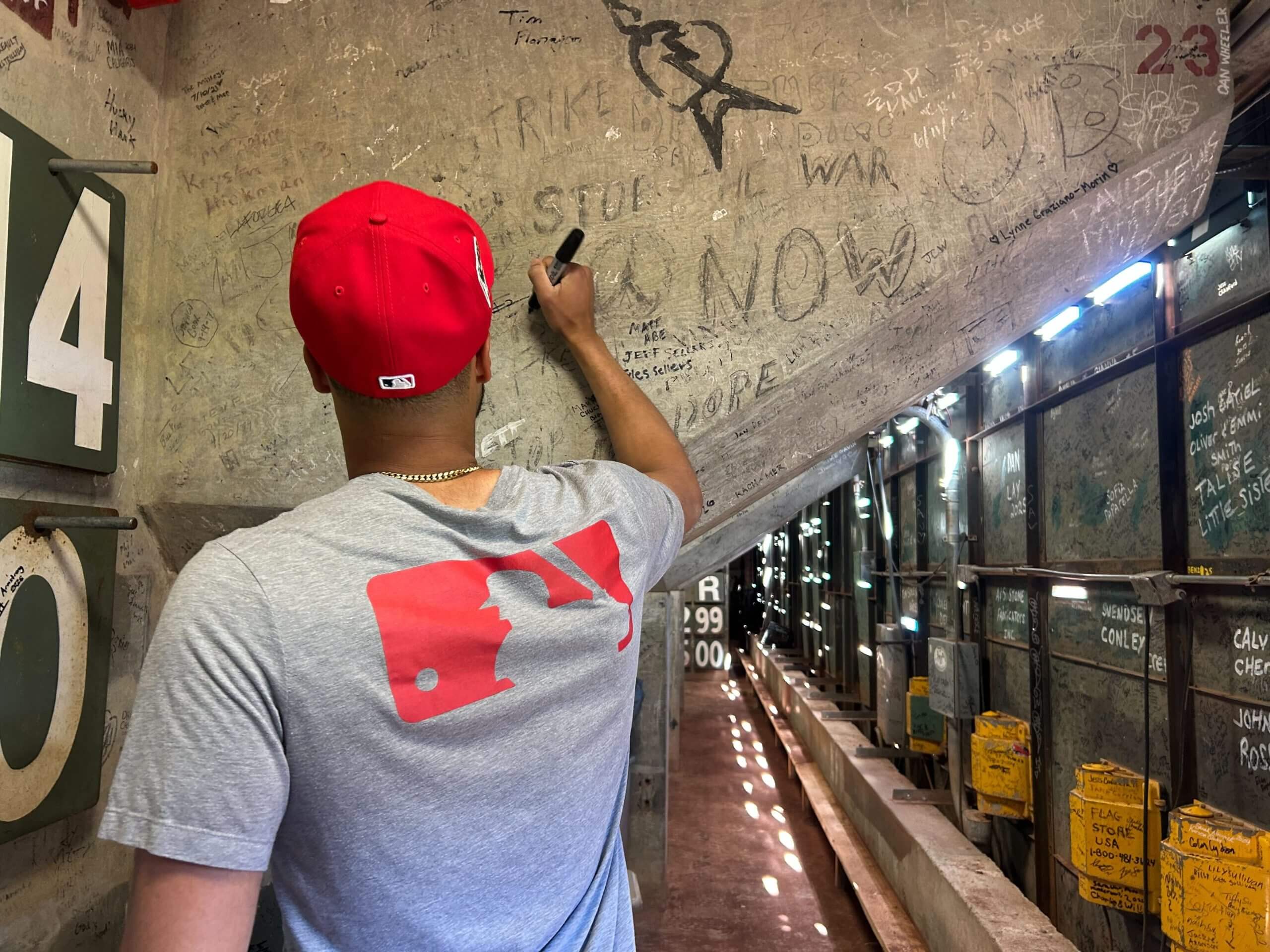
Justin Crawford adds his name to the countless signatures inside the Green Monster. (Charlotte Varnes / The Athletic)
Crawford has been here before. At Fenway Park, on the field, shagging balls during batting practice, inside major-league clubhouses. But not on the field, 36,000-plus surrounding him, willing him not to make a catch. It all looks different as a player. There is so much left to learn and see.
There have been many big firsts over the past month, but before a 2-1 Phillies win Tuesday, Crawford crossed off a small one. He entered the door to the Green Monster, Sharpie in hand. He had never visited the famed room behind Fenway’s scoreboard despite all the time he spent at the field as a kid.
“Wow,” he said, looking at the walls of signatures surrounding him.
Crawford picked a concrete beam to sign. Then he retreated to the clubhouse and returned to the field with a bat. It was time to work.
— Matt Gelb contributed to this report.