House Republicans overcame widespread Democratic opposition on Thursday to approve a bill funding the Department of Homeland Security, the federal agency spearheading Donald Trump’s immigration crackdown.
The 220-207 vote, with seven Democrats joining nearly all Republicans, came amid mounting outrage over its heavy-handed and violent tactics in Minnesota and elsewhere.
Democrats’ opposition to the DHS funding measure had grown in recent weeks since an Immigration Customs and Enforcement (ICE) agent shot and killed Renee Good, a 37-year-old US citizen, in Minneapolis earlier this month.
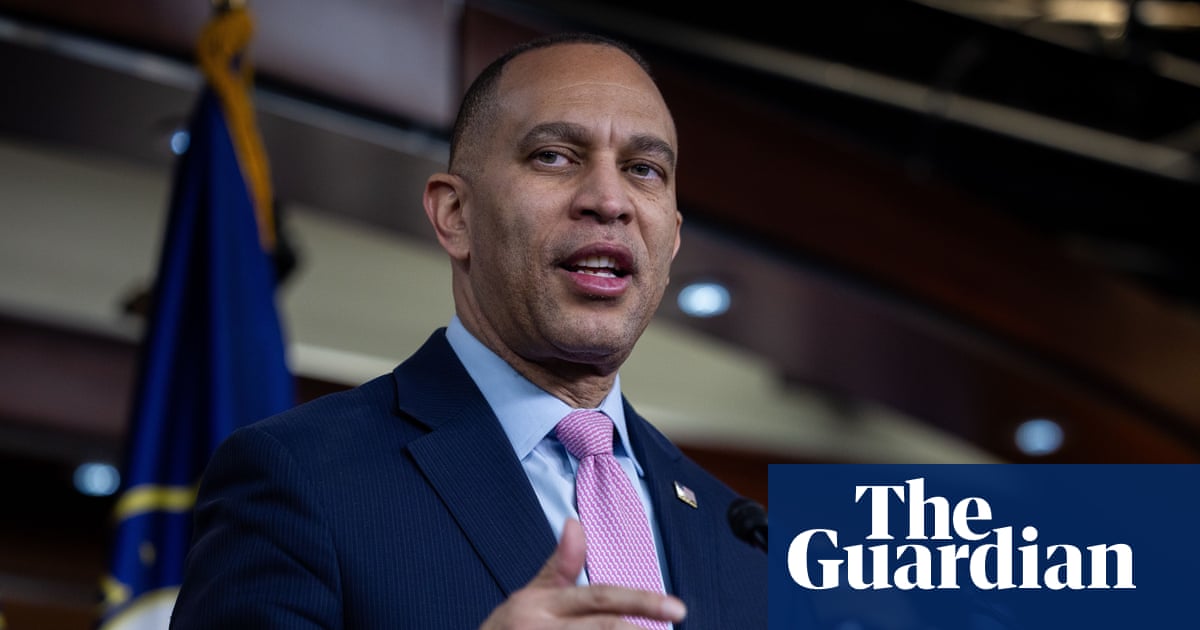
“Taxpayer dollars are being misused to brutalize US citizens, including the tragic killing of Renee Nicole Good,” the Democratic leader, Hakeem Jeffries, Democratic whip, Katherine Clark, and Democratic caucus chair, Pete Aguilar, said in a joint statement on Wednesday. “This extremism must end.”
The House on Thursday also approved a package of three measures to fund the defense, labor, health, education, transport and housing departments through 30 September. The broader package was approved with strong bipartisan support, on a 341-88 tally. The funding measures now move to the Senate, which must act by 30 January to avoid a partial government shutdown.
The speaker, Mike Johnson, hailed the votes to approve the year’s final batch of spending bills as “another monumental achievement”.
“Republicans have delivered once again in making the America First agenda a reality,” he said in a statement. “We have finally turned the page, and we are not turning back.”
Party leaders told a closed-door meeting on Capitol Hill on Wednesday that they would vote against the homeland security funding bill, citing insufficient provisions to rein in ICE. However, they did not whip their caucus against the funding bill.
In the Senate, the outstanding funding bills are expected to be stitched together into one big package, putting pressure on Senate Democrats who want to use the measure as leverage to constrain ICE.
Several Democrats have already announced their opposition, including the Arizona senator Ruben Gallego, who announced on Wednesday: “Yeah, I am not voting to give whatever ICE has become more taxpayer money. It’s no longer an immigration enforcement arm of the US government.”
Still, other Democrats are unlikely to reject spending for the defense department and other key domestic agencies.
The Democratic thumbs-down in the House came despite provisions in the bill that keep the agency’s $10bn annual budget flat, reduces ICE enforcement and removal operations, and imposes a 5,500 reduction to its number of detention beds. The legislation also secured $20m for the “procurement, deployment, and operations of body worn cameras” to be worn by ICE agents, thanks to Democrats’ efforts.
Such palliatives are unlikely to placate anger in the party over the agency’s operations in Minnesota.
“In the last 24 hours, we’ve heard our members speak loudly that ICE isn’t doing enough, these reforms aren’t doing enough. This lawlessness has to stop,” Aguilar told reporters after a Wednesday meeting on Capitol Hill. “They are only doing this because the president of the United States wants to use them to terrorize communities, to terrorize US citizens.”
Rosa DeLauro, a representative from Connecticut and the ranking Democrat on the appropriations committee, said it was still better for the bill to pass rather than run the risk of a renewed government shutdown that could affect other agencies. “I understand that many of my Democratic colleagues may be dissatisfied with any bill that funds ICE,” she said.
“I share their frustration with the out-of-control agency. I encourage my colleagues to review the bill and determine what is best for their constituents and communities.”
But she added: “The homeland security funding bill is more than just ICE. If we allow a lapse in funding, TSA [transportation security administration] agents will be forced to work without pay, Fema [federal emergency management agency] assistance could be delayed, and the US Coast Guard will be adversely affected. All while ICE continues functioning without any change in their operations due to $75 billion it received in the One Big Beautiful Bill.”
DeLauro ultimately ended up voting against the bill.