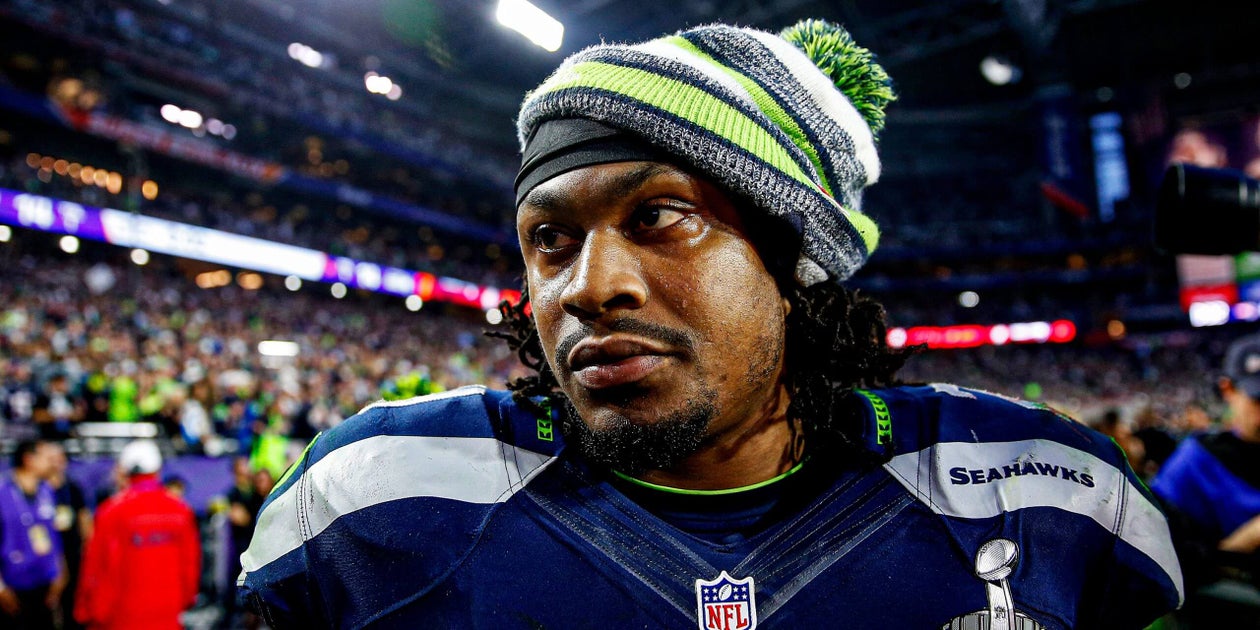
SAN FRANCISCO — When it happened, as tens of millions of viewers let out yelps of indignation, elation or anguish, Marshawn Lynch laughed.
You probably weren’t aware of the mystified running back’s exact reaction, but you surely know the play that provoked it. Eleven years ago, the Seattle Seahawks were on the verge of securing a second consecutive Super Bowl victory, a yard away from a triumphant touchdown that was set up to be Lynch’s. Like everyone else, the powerful running back was shocked that coach Pete Carroll went with a different call: a Russell Wilson slant that was intercepted by Malcolm Butler, then a rookie cornerback for the New England Patriots.
Suddenly, it was over. The Seahawks had squandered a chance to win Super Bowl XLIX and, it would turn out, a shot at creating a dynasty. As Lynch looked over to the Seattle sideline and saw the tortured look on teammate Richard Sherman’s face, his own mouth dropped, and he did what came naturally.
“I could hear the emptiness, and I saw Sherm with a traumatic-ass face, like, ‘What the f— just happened? Like, God, are you serious?’” Lynch would recall years later. “And then at that moment, all I could do was laugh. Literally, like a dramatic-ass laugh. Mouth wide open — one of them kind of laughs.”
With the Seahawks and Patriots set to face off in Super Bowl LX on Sunday in Santa Clara, Calif., there has been renewed focus on what probably ranks as the most infamous play in the Ultimate Game’s six-decade history. It’s a subject I’ve explored in depth, beginning in the immediate aftermath — when Carroll attempted to explain his decision in a late-night text exchange — and throughout the years that followed.
In 2022, Lynch and I collaborated (in conjunction with Backstage Media and Meadowlark Media) on an as-yet-unreleased documentary project, “One Yard,” exploring the impact of that triggering moment. The quotes in this column are excerpts from separate on-camera interviews with Lynch, Carroll and Seahawks general manager John Schneider, each of whom conceded that the healing process following that heartbreaking defeat was long, complicated and tumultuous.
To Lynch, Carroll choosing to green-light offensive coordinator Darrell Bevell’s play call on second-and-goal from the 1 while trailing by 4 points with 26 seconds remaining wasn’t merely a perplexing move. In its aftermath, it also came to represent — for him and other players — a broken pact between the coaches and the men in uniform.
“It took confidence (away from) what the coaching staff and what the organization was preaching,” Lynch explained. “(Carroll) preaches, ‘We’re gonna run the ball down your throat,’ and all that type of s— like that. I think it took a lot of respect from them, ’cause they weren’t standing on s—. They weren’t ‘10 toes’ on what the f— they were preaching.”
Lynch’s ferocious running style had been an essential part of the Seahawks’ identity since Seattle acquired the 2007 first-round pick in a midseason trade with the Buffalo Bills in 2010, Carroll’s first year as coach.
After an unlikely NFC West title (despite a 7-9 record), the Seahawks stunned the defending Super Bowl champion New Orleans Saints in a first-round playoff game, with Lynch’s Beast Quake run providing the signature moment. The incredible 67-yard play concluded with Lynch leaping into the end zone and — well, let’s let Carroll tell it.
“And Marshawn, just in classic fashion, goes in, you know, holding his Schwanz as he goes across the goal line.”
By 2013 the Seahawks, with a relentless, punishing and explosive defense that mirrored Lynch’s playing style, were the class of the NFL. They made it official with a 43-8 blowout of the Denver Broncos in Super Bowl XLVIII.
The next season, the Seahawks’ stirring rally in the final minutes of regulation produced an epic NFC Championship Game victory over the Green Bay Packers. After that wild comeback, Lynch was convinced a second consecutive Lombardi Trophy would be theirs for the hoisting.
And after Jermaine Kearse’s amazing, four-bobble catch gave the Seahawks a first-and-goal at the 5 late in Super Bowl XLIX, Lynch had no doubt that he and his teammates would finish the job. He came close to doing it on the first-down carry, getting stopped just inside the 1, and was sure he’d score on the next play — until the call came in.
Carroll had his strategic reasons for passing, given that Seattle had one timeout, didn’t want to be boxed into throwing on third down and was facing a Patriots defense designed to stop a short-yardage run. Yet none of that resonated at the time.
“You could just see when the play call came in, motherf—–s are just looking around, like, ‘What the f—?’” Lynch said. “I don’t even think it really probably registered to a lot of individuals. I know for sure it didn’t register to me at first, ’cause I think I lined up on the opposite side.”
Butler’s interception was hard to process in a locker room full of proud, headstrong players who were mystified by the fact that the ball — and Seattle’s fate — hadn’t been in Lynch’s hands. Instead Wilson, considered a teacher’s pet by many of his edgier teammates, had been asked to throw the potential game-winning pass, with disastrous results.
After the game, the anger was palpable. Following his initial fit of laughter, Lynch’s next thought was, “S—, I got a bottle of Pure White Hennessy in the locker room, and it’s time to go get loaded.”
Lynch bolted early, then went on a multiday bender in Las Vegas, attempting to dull his pain.
When the Seahawks reconvened during the spring and summer of 2015, things weren’t the same.
Carroll, Schneider remembered, “brought up the grieving thing himself right away. Like maybe the next day, he started talking about it.”
Said Carroll: “There was a grieving, and I knew I was right in the center of everybody’s grief. We were going to face it and deal with it and let people have their space to get it done. It was just hard on everybody. It took people a long time.
“When does it go away? I’ll let you know.”
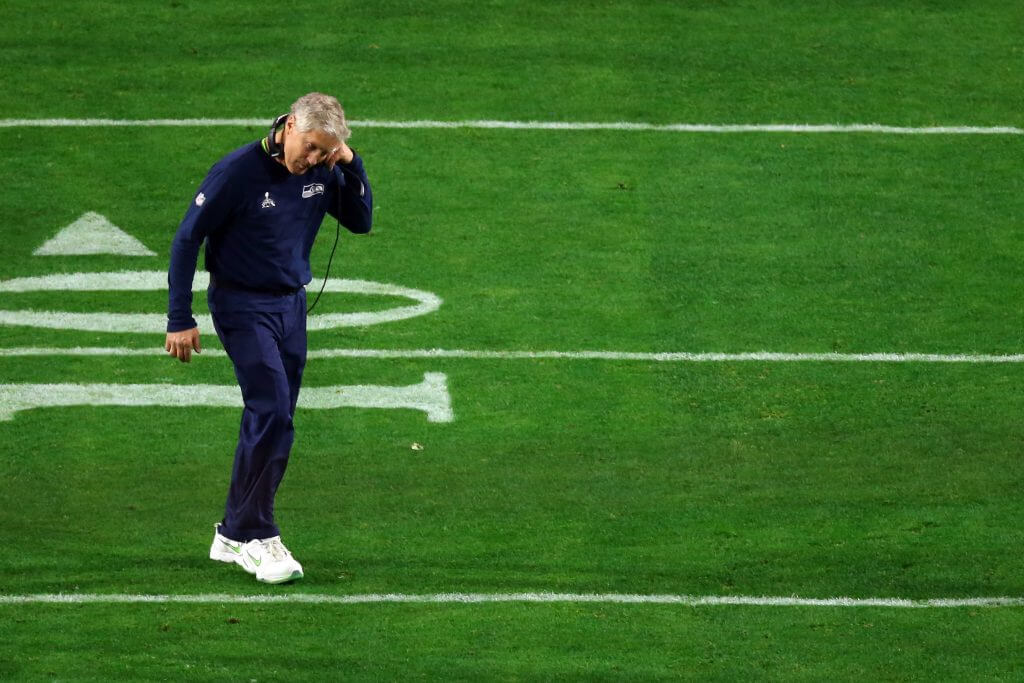
“There was a grieving, and I knew I was right in the center of everybody’s grief,” Pete Carroll said of a loss in Super Bowl XLIX. (Mike Ehrmann / Getty Images)
In Lynch’s eyes, it never really did. Once he and other players felt as though Carroll and his assistants had gone against what they’d claimed to stand for in that pivotal moment, trust was broken and suspicions were high.
“Hell yeah, it felt different,” Lynch recalled. “It felt like we had to go to work. Before, work didn’t feel like work; it was basically like a hangout. (But) just like with anything, if you deal with an unsolid individual — once they show you their hand — then you deal with them accordingly. And motherf—–s started dealing with the motherf—–s accordingly.
“Then, you know, it just became a s—show. It was a friction between what the players stood on and what they saw the coaches standing on. They weren’t standing on their word.”
Despite the fallout, it’s not as though Carroll’s Seahawks crumbled. They reached the divisional round of the 2015 playoffs and made additional postseason appearances in 2016, 2018, 2019, 2020 and 2022. The scars remained — Sherman, the team’s star cornerback, threw a sideline tirade during a 2016 game in which the Seahawks called a passing play from the Los Angeles Rams’ 1-yard line, later telling reporters, “Yeah, I was letting (Carroll) know. We’ve already seen how that goes.”
And yet, even as Lynch, Sherman and other key players departed the organization, there was healing behind the scenes. When the Seahawks suffered a rash of injuries at running back late in the 2019 season, Schneider and Carroll turned to Lynch — who’d abruptly retired after the 2015 season, returned to play for the Oakland Raiders in 2017 and retired again following the 2018 campaign — as a blast from the past.
Lynch’s return was full of good vibes and featured a surreal moment: With the Seahawks hosting the San Francisco 49ers in the regular-season finale — a game that decided the NFC West title and the conference’s No. 1 playoff seed — Seattle was a yard away from the winning score.
The stadium was charged with anticipation. A euphoric and purifying celebration was there for the taking.
This time, Carroll had clarity and conviction: Lynch was getting the rock.
“Heck yeah, he was,” Carroll said. “For all of the reasons. He was the right guy at the right time, and it was just a moment we needed to capture.”
Alas, a delay of game penalty derailed the plan, and Seahawks tight end Jacob Hollister was ultimately stopped inches short of the goal line.
Seattle also came up short in Carroll’s final four seasons before he was fired by owner Jody Allen.
Now, in successor Mike Macdonald’s second year, the Seahawks are finally back in the Super Bowl, a new team attempting to carve its own place in football history.
As for the team that came so close to winning back-to-back titles 11 years ago?
Well, in Lynch’s words, the Seahawks of that era will be known as The Almost.
“I think we could have (been a dynasty),” he said, “because our ability was probably unmatched.”
Instead, those Seahawks will go down as the team that lost a chance to win a second consecutive championship in an excruciating manner — and couldn’t recover from the resulting ramifications.
“Regardless of us winning a Super Bowl in the fashion that we did,” Lynch said, “I think it’s always gonna be overshadowed by the Super Bowl that we lost in the fashion that we did.”
He wasn’t laughing when he said it.